Lia Robin
Robin Hood's Bay is a historic English coastal village with a past steeped in smuggling, fishing, and folklore.
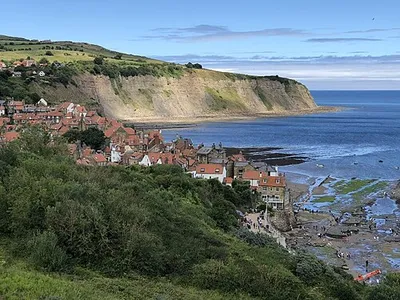
Robin Hood's Bay is a village located on the Yorkshire Coast in North Yorkshire, England, situated between Whitby and Scarborough. It lies within the North York Moors National Park and is a popular tourist destination. The village's name has uncertain origins, with early records dating to the 16th century. While a ballad associates Robin Hood with the area, historical evidence for his presence is considered unlikely. The village's history is marked by its role as a port, its significant smuggling activities during the 18th century, and its traditional fishing and farming livelihoods.
Historically, Robin Hood's Bay was a more prominent port than Whitby in the 16th century. Its maze-like streets are reputed to conceal underground passages, remnants of its smuggling past. Contraband, including tea and spirits, was brought ashore to evade duties. The village also has a history of maritime rescues, notably an event in 1881 where a lifeboat was transported overland to save a stranded crew. While fishing declined in the late 19th century, the village now relies heavily on tourism and is also known for its fossil-rich beaches and a former marine laboratory.
Historical Identity and Folklore
The name Robin Hood's Bay has origins that are not definitively known, with its first recorded mention appearing in 1544 as 'Robyn Hoodis Baye'. While a 17th-century ballad links the legendary Robin Hood to Scarborough and potentially the bay, historical consensus suggests it's improbable that the figure ever visited the area, or even existed. It's speculated that the ballad author might have connected their story to the locality to explain the place name. Early historical references from the 14th century indicate that Flemish fishermen and their vessels were forcibly taken to 'Robyn Oeds Bay'. By the 16th century, the settlement had grown to become a small fishing port, described as a 'fischer tounlet of 20 bootes'.
Smuggling and Maritime Traditions
Robin Hood's Bay has a long-standing reputation for smuggling, facilitated by its intricate network of narrow streets and alleged subterranean passages. During the late 18th century, the Yorkshire coast was a hub for such illicit activities, with vessels from the continent delivering contraband like tea, gin, rum, and brandy to avoid taxes. These operations were financed by syndicates, separating them from the risks taken by sailors and locals. The village's maritime history also includes notable events, such as a confrontation in 1779 where smugglers battled excise men over a significant quantity of brandy and tea. The village's primary legitimate industries were historically fishing and farming, with many families deeply involved in the fishing trade, utilizing cobles and larger boats for various types of catch.
Cultural and Scientific Significance
The village has inspired various cultural works, serving as the setting for Leo Walmsley's Bramblewick novels and being featured in films such as 'Turn of the Tide,' 'Wild Child,' and 'Phantom Thread.' The Fylingdales Group of Artists was established in Robin Hood's Bay in 1925. Notably, the area is also recognized for its geological importance, with the Wine Haven Profile near the bay designated as a Global Stratotype Section and Point (GSSP) for the Pliensbachian Epoch of the Early Jurassic. Furthermore, the Robin Hood's Bay Marine Laboratory operated from 1912 to 1983, contributing to scientific research in the region.
Key Ideas
- The historical and folkloric association of the village with the legendary Robin Hood, though likely unsubstantiated.
- The village's significant past as a center for smuggling operations.
- The geological importance of the local stratigraphy, particularly for the Pliensbachian Epoch.
- The village's role as a setting for literary and cinematic works.
Books by Lia Robin
2 free public domain books · Read online or download