Leo Zodiac Sign Designs
The Voynich manuscript is a mysterious 15th-century illustrated codex written in an unknown script, whose origins and purpose remain undeciphered.
The Voynich manuscript is a unique, illustrated codex carbon-dated to the early 15th century, likely originating from Italy during the Renaissance. Its text is written in an unknown script, referred to as Voynichese, and accompanied by intricate illustrations depicting plants, astrological symbols, and human figures. The manuscript's authorship, purpose, and the meaning of its text are subjects of ongoing debate and study, with no definitive translation or explanation currently available.
Despite extensive analysis by cryptographers, linguists, and historians, the manuscript has resisted decipherment. Its physical characteristics, including the vellum, ink, and pigments used, have been studied to understand its creation. The manuscript's known ownership history begins with Georg Baresch in the 17th century, and it was later acquired by Wilfrid Voynich in 1912, after whom it is named. Currently, it is housed at Yale University's Beinecke Rare Book and Manuscript Library, where it has been digitized and made accessible online, continuing to fuel scholarly and public fascination.
Physical Characteristics and Dating
The Voynich manuscript is a codex comprising approximately 240 vellum pages, with evidence suggesting some pages are missing. Radiocarbon dating places the vellum between 1404 and 1438, with stylistic analysis pointing to an Italian Renaissance origin. The parchment, made from calfskin, shows signs of considerable handling, suggesting a functional rather than ceremonial purpose. The text is written from left to right using iron gall ink, and illustrations are colored with inexpensive pigments such as azurite, red ochre, and copper-based greens. Some sections of the text and drawings appear to have been retouched or modified using darker ink over fainter, earlier script.
The Enigmatic Script and Illustrations
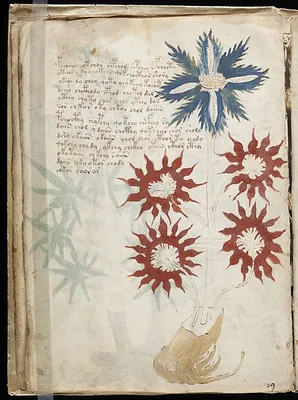
The manuscript's text is rendered in an unknown script, Voynichese, composed of an estimated 20-25 core characters, with a few rarer ones. Statistical analysis reveals patterns consistent with natural language, though its structure remains undeciphered. The approximately 38,000 words, divided into about 35,000 word tokens, display unique structural characteristics. Accompanying the text are numerous illustrations, including botanical drawings of unidentified plants, astrological diagrams featuring celestial symbols, and depictions of human figures, some in bathing scenes. These illustrations, along with the unusual script, contribute significantly to the manuscript's enduring mystery.
History and Unsuccessful Decipherment Attempts
The earliest confirmed owner was the 17th-century alchemist Georg Baresch. The manuscript gained wider recognition after being purchased by Polish book dealer Wilfrid Voynich in 1912. Despite efforts by numerous professional and amateur cryptographers, including World War I and II codebreakers, the Voynich manuscript has never been demonstrably deciphered. Hypotheses regarding its nature range from a natural or constructed language, a complex cipher, a work of fiction, or even a hoax. None of the proposed interpretations have achieved independent verification, leaving its origins, authorship, and purpose subjects of ongoing speculation.
Key Ideas
- The Voynich manuscript is an illustrated codex written in an unknown script (Voynichese).
- Carbon dating places its vellum in the early 15th century, with stylistic analysis suggesting an Italian Renaissance origin.
- Its purpose, authorship, and the meaning of its text remain unknown and are subjects of intense debate and study.
- Despite extensive cryptanalytic efforts, the manuscript has not been deciphered.
- The manuscript features unique illustrations of plants, astrological symbols, and human figures.
Books by Leo Zodiac Sign Designs
2 free public domain books · Read online or download