Kelly Wallace
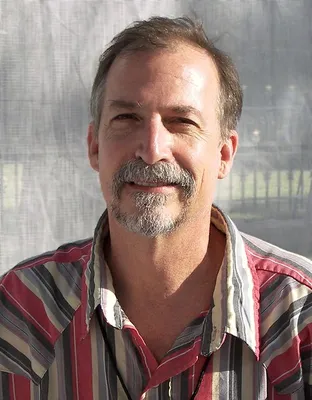
Daniel Wallace is an American author known for "Big Fish," exploring themes of myth and the nature of reality.
Daniel Wallace, born in 1959 in Birmingham, Alabama, is an American author recognized for his 1998 novel "Big Fish: A Novel of Mythic Proportions." His literary career includes other notable works such as "Ray in Reverse" and "The Watermelon King," with stories appearing in various anthologies and magazines. Wallace's academic background includes studies in English and philosophy at Emory University and the University of North Carolina at Chapel Hill. He has spoken about his childhood as uneventful but acknowledged familial friction. His path to writing involved a period working for his father's import/export company in Japan, which ultimately did not fulfill him, leading him to pursue writing more seriously. He has resided in Chapel Hill, North Carolina, with his wife and son, and has worked as a veterinary assistant, in a bookstore, and as an illustrator. A recurring motif in his work is the collection of glass eyes. Wallace identifies as "left of center. Far left" politically and describes himself as agnostic, viewing inexplicable events and profound creative acts as natural rather than supernatural phenomena.
Literary Contributions and Themes
Prior to the success of "Big Fish," Daniel Wallace experienced numerous rejections for his early novel manuscripts. His work has since been translated into 18 languages, and "Big Fish" was adapted into a film by Tim Burton. Wallace has expressed a degree of surprise that "Big Fish," with its more mythic narrative, was the book chosen for adaptation over his other works that he considered to have clearer structural arcs. His bibliography includes "Ray in Reverse," "The Watermelon King," "Mr. Sebastian and the Negro Magician," and "The Kings and Queens of Roam." Wallace posits that "art is a distillation of experience," suggesting a deep connection between lived reality and creative output. He views writing as an accessible art form, requiring minimal tools, and reflects on his early writing process as driven by the pure pleasure of invention, sometimes at the expense of narrative coherence or audience consideration. He acknowledges learning not only what to write but also what not to write, a process that culminated in the breakthrough of "Big Fish."
Philosophical and Personal Reflections
Wallace's perspective on life and belief is characterized by a grounded, empirical outlook. He identifies as agnostic, explaining that he doesn't attribute inexplicable events or his own creative capabilities to divine intervention. Instead, he views such occurrences, whether personal artistic breakthroughs or seemingly miraculous survivals, as inherent aspects of human experience and psychology, perhaps rooted in our evolutionary past. He states, "I think a lot of people default to Jesus when something inexplicable happens... We’re hard-wired to do this, I think, because we’ve been doing it since the beginning." His political stance is described as "left of center. Far left." Wallace's personal life includes living in Chapel Hill, North Carolina, with his wife, Laura, a social worker, and their son, Henry. He has also mentioned his collection of glass eyes as a recurring motif in his writing.
Academic and Teaching Career
Daniel Wallace holds a position as a professor and lecturer within the English Department at the University of North Carolina, Chapel Hill. His teaching philosophy centers on cultivating an appreciation for the craft of writing among his students. He aims to demystify the creative process for undergraduates, enabling them to better understand and value literary works. While acknowledging that few students pursue writing professionally beyond their academic studies, Wallace endeavors to equip them with a foundational understanding of narrative techniques. He notes that the undergraduate program is structured such that students rarely emerge with a uniform style, suggesting a focus on individual development rather than homogenization.
Key Ideas
- Art as a distillation of experience.
- The nature of narrative and myth.
- Writing as an accessible art form.
Notable Quotes
“I was completely average in every way. My childhood was the most uneventful part of my life, I think.”
“My father wanted me to work with him in his company, an import/export firm, and to that end I lived in Japan for a couple of years. But it didn’t work out. It didn’t make me happy and the truth is I wasn’t that good at it. I wouldn’t have been a good businessman. I tried. So I quit – or, if he were alive and you could ask him, fired – and started writing. He wasn’t for it but then it’s hard to support a child in an endeavor for which he has shown absolutely no promise. My mother loved the idea of it because being a writer is such a romantic idea and because it hurt my father, and if he was hurt she was happy.”
“It is fair to say that I'm left of center. Far left.”
“I think a lot of people default to Jesus when something inexplicable happens. I write things I didn’t know I was capable of writing, and sometimes that feels like magic. It isn’t; it’s just me. A similar thing happens when a tornado blows someone’s house away, but their cat is found unscathed in an oak tree: God must have been looking out for Pooky. We’re hard-wired to do this, I think, because we’ve been doing it since the beginning.”
“I thought I was a much better writer then than I do now. I loved the stories I was coming up with, and was really amazed I could put enough sentences together to make a paragraph. It was like magic, seeing the little black marks all come together. I sound like I’m making fun of myself but I’m not. If a writer writes I was a writer. I couldn’t see very far beyond that though. The pure pleasure of invention, of making stuff up, clouded over everything else. I couldn’t tell the difference between a good story and a good story told well. I wrote three hundred pages about a pair of billionaire twins, each weighing just over 500 pounds, who ‘rent’ the mistress of one of their friends. What did I think was going to come of that? Nothing much did. And I wrote a few other books equally as promising. As I wrote I was learning to write (having not gone to school) and I was learning what not to write as well. I also finally figured out that I was writing the kind of books I thought other people wanted to read, not the kind I wanted to write. That’s when Big Fish happened, and why it was a breakthrough for me.”
Books by Kelly Wallace
3 free public domain books · Read online or download