Joseph Naveh Shaul Shaked
Abraxas is a significant figure in Gnosticism, often depicted as a Great Archon or deity, whose name holds mystical significance and appears on ancient amulets.
Abraxas, also spelled Abrasax, is a central term in Gnostic Christianity, identified as the 'Great Archon' or a supreme divine power. Its origins and exact meaning are debated, with proposed etymologies from Egyptian, Hebrew, and Greek languages, though none are definitively proven. The name appears in various Gnostic texts, including the Holy Book of the Great Invisible Spirit and the Apocalypse of Adam, as well as in ancient magical traditions and on engraved gemstones known as Abraxas stones, which were used as amulets.
In early Christian writings that documented Gnostic beliefs, Abraxas is described with varying roles. Some accounts, particularly those detailing the teachings of Basilides, portray Abraxas as the ruler of 365 heavens, with his name numerically corresponding to 365, the days of the year. Other interpretations identify Abraxas as a supreme deity, the cause and first archetype of all things, or a divine being who sent Christ. However, primary Gnostic sources, like those found in the Nag Hammadi library, suggest a different cosmological placement, often depicting Abraxas as an Aeon dwelling with Sophia at the boundaries of the divine realm, interacting with the material world and its ignorance.
Mystical Name and Etymology
The name Abraxas, with its initial attested spelling Abrasax, is a significant term within Gnosticism, appearing in ancient texts and on mystical gemstones. While its precise origin remains elusive, scholars have proposed numerous etymologies. Some suggest Egyptian roots, linking it to concepts like 'honorable word' or 'hurt me not.' Hebrew derivations have been suggested, such as 'The Blessing' or a compound meaning 'the uncreated Father' (father, create, negative). Greek interpretations include 'the beautiful, glorious Savior' or connections to names found in corrupted classical texts. The numerical value of the Greek letters in ΑΒΡΑΣΑΞ is 365, a number often associated with the days of the year and the heavens in Gnostic cosmology. The variation in spelling, from Abrasax to the more common Abraxas, is thought to have arisen from Latin transliteration or phonetic shifts.
Role in Gnostic Cosmogony
Within Gnostic traditions, Abraxas holds a complex and sometimes contradictory position. Early heresiological accounts, which documented Gnostic beliefs from a proto-Orthodox Christian perspective, often describe Abraxas as a supreme Archon, ruling over 365 heavens. In these narratives, Abraxas is depicted as a powerful intermediary figure in the creation of the cosmos and humanity. However, analysis of primary Gnostic texts, such as those from the Nag Hammadi library, presents a different view. Here, Abraxas is often identified as an Aeon, a divine emanation, residing in the Pleroma (the divine realm) alongside other Aeons like Sophia. In this context, Abraxas is associated with the outer boundaries of the divine presence, interacting with the material world and the ignorance that characterizes it, playing a role in the unfolding of the Gnostic drama.
Abraxas Stones and Magical Practices
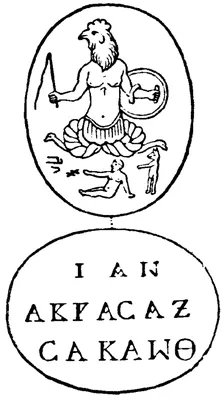
The name Abraxas is famously associated with a collection of ancient engraved gemstones, known as Abraxas stones. These artifacts, often featuring mythological or grotesque imagery alongside inscriptions, were widely used as amulets or charms. The inscription ΑΒΡΑΣΑΞ frequently appears on these stones, sometimes accompanied by other mystical words or names. The practice of engraving potent names on objects for magical purposes was common in the Greco-Roman world, and Abraxas stones fit within this tradition. Their use highlights the belief in the power of divine names and symbols to offer protection, influence events, or connect the wearer with spiritual forces. The exact function and meaning attributed to these stones varied, but their prevalence underscores the mystical significance attributed to the name Abraxas.
Key Ideas
- Abraxas as the Great Archon in Gnosticism
- Numerical significance of Abraxas (365)
- Abraxas stones as amulets
- Debated etymology of the name Abraxas
- Abraxas as an Aeon in Sethian Gnosticism
Books by Joseph Naveh Shaul Shaked
0 free public domain books · Read online or download
