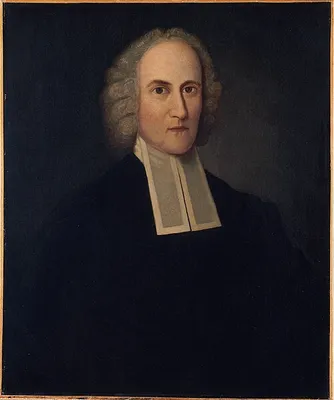
Jonathan Edwards
Jonathan Edwards was a pivotal American theologian and philosopher, influential in the First Great Awakening and known for his complex theological and philosophical writings.
Jonathan Edwards (1703–1758) was a prominent American revivalist preacher, philosopher, and theologian whose work significantly shaped religious thought in colonial America. Rooted in Puritan traditions, his theological ideas were also deeply influenced by Enlightenment philosophy, particularly thinkers like John Locke. Edwards is widely recognized as one of America's most original philosophical theologians.
He played a crucial role in the First Great Awakening, leading revivals in Northampton, Massachusetts, which he documented in his writings. His famous sermon, "Sinners in the Hands of an Angry God," delivered in 1741, became a classic of early American literature. Edwards's intellectual pursuits extended beyond theology; he maintained a keen interest in natural science, observing and writing about phenomena like spider ballooning, and saw the natural world as evidence of divine design. His theological system, known as New England theology, explored concepts of divine sovereignty, beauty, and the nature of religious affections.
Early Life and Intellectual Development
Born in 1703, Jonathan Edwards was the only son of Timothy Edwards, a minister. His mother, Esther Stoddard, was the daughter of a notable minister and possessed notable mental gifts. Edwards entered Yale College at the young age of thirteen. During his studies, he was profoundly influenced by John Locke's "An Essay Concerning Human Understanding." He kept extensive notebooks on various subjects, including philosophy, natural science, and theology, and planned a comprehensive work on natural and mental philosophy. His early interest in science is evident in his detailed observations and writings on topics like the ballooning behavior of spiders, which he later refined to fit contemporary scientific literature. Despite the scientific advancements of his time that led some towards deism, Edwards viewed the natural world as a testament to God's purposeful creation and wisdom. He often found solace and inspiration for prayer in nature.
Theological Foundations and the Great Awakening
Edwards's theological work, while broad, was grounded in the Puritan heritage, drawing from confessions like the Westminster and Savoy. His thought emphasized conceptions of beauty, harmony, and ethical alignment, with the Age of Enlightenment significantly shaping his intellectual framework. He served as a supply pastor in New York City before returning to Yale as a tutor. In 1727, he was ordained as minister in Northampton, Massachusetts, assisting his grandfather, Solomon Stoddard. His marriage to Sarah Pierpont, a woman of deep piety, occurred in the same year. Following his grandfather's death in 1729, Edwards assumed sole pastoral charge of the large Northampton congregation. His early public ministry included sermons that challenged Arminianism, emphasizing God's absolute sovereignty in salvation. A significant spiritual revival began in Northampton in 1733, peaking in 1734–35, which Edwards meticulously studied and documented, leading to works like "A Faithful Narrative of the Surprising Work of God."
Ministry, Sermons, and Philosophical Contributions
Edwards's role in the First Great Awakening was central. He delivered the impactful sermon "Sinners in the Hands of an Angry God" in 1741, a seminal piece of early American literature. His writings explored the nature of religious experience, with "Religious Affections" remaining influential among Calvinist Evangelicals. He grappled with the psychological aspects of conversion and spiritual distress, noting periods where intense religious fervor led to despair and even suicide among some individuals. Edwards's philosophical theology integrated Enlightenment ideas with Puritan doctrine, exploring the beauty of God and the role of aesthetics in spiritual life, anticipating later theological aesthetics. He also maintained a deep engagement with scientific discoveries, interpreting them through a theological lens that saw divine wisdom in natural laws.
Key Ideas
- Emphasis on God's absolute sovereignty in salvation
- Theological exploration of beauty, harmony, and ethical aptness
- Influence of the Age of Enlightenment on theological thought
- Detailed psychological study of religious conversion and experience
- View of the natural world as evidence of divine design
- Doctrine of a special grace and supernatural divine illumination of the soul
Books by Jonathan Edwards
2 free public domain books · Read online or download