John J Collins
The Tom Collins cocktail's origins are debated, with early recipes appearing in the late 19th century, possibly linked to a hoax.
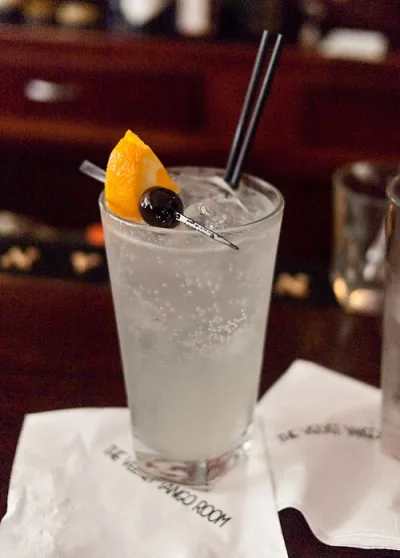
The Tom Collins is a mixed drink made with gin, lemon juice, sugar, and carbonated water, often served with a cherry. Its history is intertwined with the John Collins, a similar beverage. Early published recipes for both appeared in Harry Johnson's 1882 bartending manual. The Tom Collins recipe specified Old Tom gin, while the John Collins called for Holland Gin. Cocktail historian David Wondrich suggests a resemblance to 19th-century gin punches served in London clubs. A 1891 article by Sir Morell Mackenzie claimed England as the origin and a person named John Collins as the creator, but this was disputed. Confusion persisted, with Charles Montgomery Skinner noting its presence in "American bars" abroad in 1898. H. L. Mencken, in the 1920s, highlighted the drink's American character while acknowledging its unclear origins.
Further complicating the history is the "Tom Collins Hoax of 1874" in the United States, a practical joke involving false sightings and conversations about a non-existent person named Tom Collins, which gained significant notoriety and may have influenced the cocktail's name. Early recipes varied, with some versions using brandy or whiskey, and later recipes sometimes substituting lime for lemon juice. By 1878, the Tom Collins was popular in New York City. Modern variations continue to exist, including non-alcoholic versions and adaptations using different spirits like vodka or rum.
Early History and Inventions
The earliest known published recipes for both the Tom Collins and Fizz cocktails appeared in Harry Johnson's 1882 "Harry Johnson's New and Improved Bartender’s Manual". The Tom Collins recipe specified Old Tom gin, while the John Collins called for Holland Gin, likely Genièvre. David Wondrich, a cocktail historian, noted that the drink bears similarities to gin punches served in London clubs during the first half of the 19th century. In 1891, Sir Morell Mackenzie incorrectly attributed the Tom Collins' origin to England and a person named John Collins, a claim quickly refuted by the magazine Punch. Charles Montgomery Skinner observed in 1898 that the Tom Collins had become popular in international "American bars," reflecting American influence.
The Great Tom Collins Hoax of 1874
A significant event that may have influenced the cocktail's name was the "Great Tom Collins Hoax of 1874." This widespread practical joke involved individuals initiating conversations by asking if the listener had seen Tom Collins. When the listener expressed ignorance, the prankster would claim Tom Collins was nearby or talking about them. This deception, designed to make people appear foolish, was amplified by newspapers printing false sightings. The hoax became so well-known that it was memorialized in music hall songs, and some historians, like George Sinclair, believe it to be the most plausible origin for the Tom Collins cocktail's name, especially given its inclusion in Jerry Thomas's 1887 guide shortly after the event.
Recipe Evolution and Variations
Harry Johnson's 1882 recipe for the Tom Collins included sugar, lime or lemon juice, broken ice, Old Tom gin, and club soda, with specific instructions to mix well and remove the ice before serving. Later recipes showed variations: O. H. Byron's 1884 "The Modern Bartender’s Guide" featured a "John Collins' Gin" with unspecified gin, lemon juice, sugar, and soda, alongside a "Tom Collins' Brandy" using brandy, gum syrup, and maraschino liqueur. Scientific Barkeeping in 1884 listed a John Collins with Holland gin and a Tom Collins with whiskey. Jerry Thomas's 1887 recipe called for gum syrup, lemon juice, gin, ice, and soda water. The distinction from a Gin Fizz was noted, with the Collins being more of a "gin and sparkling lemonade" due to the larger amount of lemon juice. By 1878, the Tom Collins was a recognized favorite in New York City establishments. Modern iterations include non-alcoholic mixes and variants like the Vodka Collins, South Side, and Rum Collins.
Key Ideas
- Debated origins of the Tom Collins cocktail.
- Influence of the "Great Tom Collins Hoax of 1874" on the drink's name.
- Evolution of cocktail recipes and ingredients over time.
- Distinction between Tom Collins and John Collins cocktails.
Books by John J Collins
0 free public domain books · Read online or download
