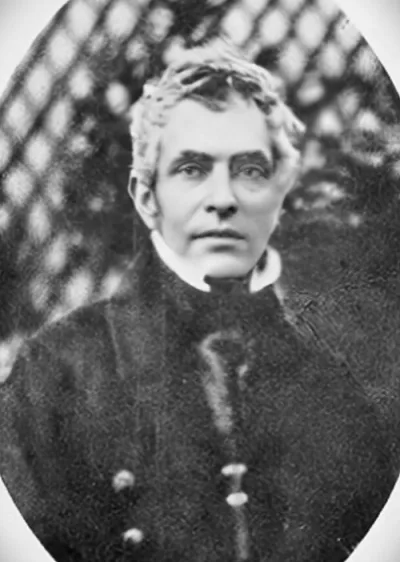
John E Nelson
John Nelson Darby was a Bible teacher and founder of the Exclusive Brethren, known for modern dispensationalism and pre-tribulation rapture theology.
John Nelson Darby (1800–1882) was a significant figure in 19th-century evangelical Christianity, particularly within the Plymouth Brethren movement, which he helped found and later led its Exclusive branch. Born into an Anglo-Irish landowning family, he was educated at Westminster School and Trinity College Dublin, where he graduated with honors. After a brief period considering law, Darby was ordained as an Anglican clergyman in Ireland. During his early ministry, he focused on converting Roman Catholic peasants but resigned his position in protest over an oath of allegiance required of converts. A subsequent injury led him to develop his theological views, including the idea that the Christian church and the Old Testament kingdom were distinct, and that the concept of clergy was a sin against the Holy Spirit. He was instrumental in establishing the Plymouth Brethren movement, characterized by its rejection of a formal clergy and emphasis on the "breaking of bread" as a symbol of unity. Darby was also a prolific translator of the Bible and a proponent of "dispensationalism" and "pre-tribulation rapture" theology, ideas that gained considerable influence, particularly in the United States through the Scofield Reference Bible. His writings were extensive, and his theological interpretations, while influential, also drew criticism from contemporaries.
Early Life and Theological Development
John Nelson Darby was born in London in 1800 and later christened in 1801. He hailed from an Anglo-Irish landowning family and received his education at Westminster School and Trinity College Dublin, where he excelled academically. During his studies, Darby experienced a Christian conversion. He briefly considered a legal career but found it incompatible with his religious convictions. He was ordained as an Anglican clergyman in Ireland in 1825. His early pastoral work involved ministering in a parish in County Wicklow, where he succeeded in persuading Roman Catholic peasants to convert to the Church of Ireland. However, these conversions were complicated by a requirement for converts to swear allegiance to King George IV, leading Darby to resign his curacy. A serious riding accident in 1827 marked a turning point, after which he began to believe that the Old Testament kingdom and the Christian church were separate entities. Over the next few years, he developed his mature theological views, asserting that the notion of a clergyman was a sin against the Holy Spirit, as it limited the potential for any believer to be guided by the Spirit.
Founding the Plymouth Brethren and Key Doctrines
Around 1827-1828, Darby joined a group of interdenominational believers in Dublin who met to "break bread" together, symbolizing their unity in Christ. This group grew and, by 1832, began to identify as a distinct Christian assembly. As they established new assemblies in Ireland and England, they formed the movement known as the Plymouth Brethren. Darby is believed to have left the Church of Ireland around 1831. He was a prominent participant in the Powerscourt Conference (1831–1833), where he publicly articulated his views on church structure and eschatology, including the doctrine of the pre-tribulation rapture. For nearly 40 years, William Kelly served as his principal interpreter and supporter. Darby also defended Calvinist doctrines, particularly predestination, aligning with Article XVII of the Thirty-nine Articles.
Later Ministry, Translations, and Influence
Darby traveled extensively across Europe and Britain throughout the 1830s and 1840s, establishing numerous Brethren assemblies. His lectures in Geneva in 1840 solidified his reputation as a leading biblical prophecy interpreter. In 1848, a dispute over church discipline led to a split within the Brethren, resulting in the formation of the Open Brethren and the Exclusive Brethren, with Darby recognized as the primary figure among the latter, sometimes called "Darbyite" Brethren. He made several missionary journeys to North America between 1862 and 1877. Darby utilized his classical education to translate the Bible from Hebrew and Greek into several languages, including German (Elberfelder Bibel), French, and English (The Holy Scriptures: A New Translation from the Original Languages). He also authored a Synopsis of the Bible and numerous other religious writings. Despite his contributions, he declined to participate in the revision of the King James Bible. Darby is widely regarded as the originator of modern "dispensationalism" and the "pre-tribulation rapture" theory, ideas that profoundly influenced later evangelical theology, particularly through the Scofield Reference Bible in the United States. His collected writings were published during his lifetime and posthumously.
Key Ideas
- Dispensationalism: A theological framework that divides history into distinct periods or "dispensations," each marked by a different way God deals with humanity.
- Pre-tribulation rapture: The belief that believers will be raptured (taken up to heaven) before a period of great tribulation on Earth.
- Separation of Church and Kingdom: The theological view that the Christian church and the Old Testament kingdom are distinct entities.
- Rejection of Clergy: The conviction that the concept of a formal clergy is contrary to the Holy Spirit's ability to guide any believer.
Notable Quotes
“For my own part, I soberly think Article XVII to be as wise, perhaps I might say the wisest and best condensed human statement of the view it contains that I am acquainted with. I am fully content to take it in its literal and grammatical sense. I believe that predestination to life is the eternal purpose of God, by which, before the foundations of the world were laid, He firmly decreed, by His counsel secret to us, to deliver from curse and destruction those whom He had chosen in Christ out of the human race, and to bring them, through Christ, as vessels made to honour, to eternal salvation.”
Books by John E Nelson
0 free public domain books · Read online or download
