John B Lust
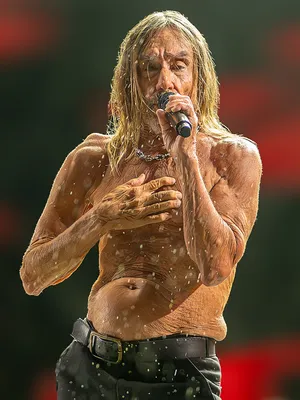
Iggy Pop, known as the 'Godfather of Punk,' is a pioneering musician celebrated for his influential stage presence and genre-bending music.
James Newell Osterberg Jr., professionally known as Iggy Pop, emerged as a significant figure in music, particularly as the lead vocalist for the proto-punk band The Stooges. Hailed as the 'Godfather of Punk,' he is recognized for his unconventional and electrifying stage performances, evocative lyrical content, and distinctive vocal delivery. His career has earned him accolades such as inclusion in the Rock and Roll Hall of Fame and a Grammy Lifetime Achievement Award. Pop's musical journey, often marked by raw, experimental rock, has spanned various genres and influenced countless artists across different musical styles. His early life in Michigan, influenced by industrial sounds and parental support for his musical interests, laid the groundwork for his innovative approach to music. The nickname 'Iggy' originated from his time in the band The Iguanas, with 'Pop' being added later due to his resemblance to a local figure. His artistic development was significantly shaped by observing performers like Jim Morrison, whose stage antics inspired Pop to explore the boundaries of performance art. This led to his signature unpredictable and often provocative stage persona, which included elements like stage diving and self-mutilation, solidifying his status as a cultural icon and musical innovator.
Early Influences and Musical Beginnings
Born James Newell Osterberg Jr. in Muskegon, Michigan, Iggy Pop's early life was marked by a fascination with the industrial sounds of the region's manufacturing plants, notably inspired by a visit to the Ford's River Rouge Plant at age nine. This early exposure to mechanical and industrial soundscapes may have contributed to his later experimental approach to music. His parents provided significant support for his burgeoning interest in drumming, even dedicating their bedroom to accommodate his kit, fostering an environment of exploration and dedication. During his junior high years, he experienced a contrasting social environment, attending school with children from affluent families, yet he felt he possessed a unique richness through his parents' investment in his passions. Conventional in his teenage years, he avoided substances, associating with popular peers. His musical journey began in Ann Arbor's high school bands, including The Iguanas, where he earned his initial nickname. He later joined blues-focused groups like The Prime Movers, where his exposure to art, politics, and experimentation deepened.
The Stooges and the Genesis of Punk Performance
After moving to Chicago to immerse himself in the blues scene and playing in local clubs, Osterberg formed the Psychedelic Stooges. Inspired by Chicago blues artists and bands like The Sonics and MC5, the group, featuring Ron Asheton on guitar, Scott Asheton on drums, and Dave Alexander on bass, debuted in Detroit. Osterberg's stage persona began to take shape after witnessing The Doors' performance, particularly Jim Morrison's confrontational and theatrical style. This encounter, coupled with influences from Mick Jagger and James Brown, encouraged Pop to push the limits of live performance, embracing antagonism and spectacle. The band, later known simply as The Stooges, signed with Elektra Records in 1968, following in the path of The Doors. Their early albums, including 'The Stooges' produced by John Cale and 'Fun House,' were characterized by a raw, primitive rock sound and confrontational performances, including acts of self-mutilation and the popularization of the stage dive. Despite limited initial commercial success, these performances and their aggressive sound laid crucial groundwork for the burgeoning punk rock movement.
Solo Career, Collaborations, and Enduring Influence
Following the initial disbandment of The Stooges due to Pop's escalating heroin addiction, he embarked on a solo career, notably collaborating with David Bowie. Their work together in West Berlin, aimed at overcoming addiction, resulted in influential albums like 'The Idiot' and 'Lust for Life,' with Pop often contributing lyrics. Bowie's reinterpretation of Pop's song 'China Girl' brought it wider recognition. Throughout his career, Iggy Pop's music has explored a diverse range of genres, from garage rock and punk to hard rock, jazz, and electronic music, demonstrating his stylistic versatility. His vocal range, described as moving from 'baritone croons' to 'unhinged shrieks,' complements his eclectic musical output. Despite fluctuating commercial success, Pop remains a significant cultural icon. The Stooges' 'Raw Power' and Pop's solo album 'The Idiot' are frequently cited as major influences on subsequent generations of musicians, impacting genres from post-punk and industrial to grunge, solidifying his legacy as a foundational figure in alternative music.
Key Ideas
- Pioneering proto-punk and punk rock music.
- Innovative and provocative stage performance style.
- Influence on various musical genres and subsequent artists.
- Exploration of diverse musical styles beyond punk.
- Themes of addiction, rebellion, and raw expression in lyrics.
Notable Quotes
“Once I hit junior high in Ann Arbor, I began going to school with the son of the president of Ford Motor Company, with kids of wealth and distinction. But I had a wealth that beat them all. I had the tremendous investment my parents made in me. I got a lot of care. They helped me explore anything I was interested in. This culminated in their evacuation from the master bedroom in the trailer, because that was the only room big enough for my drum kit. They gave me their bedroom.”
“He hung out with the popular kids that wore chinos, cashmere sweaters, and penny loafers. Iggy didn't smoke cigarettes, didn't get high, didn't drink.”
“I attended two concerts by the Doors. The first one I attended was early on and they had not gotten their shit together yet. That show was a big, big, big influence on me. They had just had their big hit, "Light My Fire" and the album had taken off. ... So, here's this guy, out of his head on acid, dressed in leather with his hair all oiled and curled. The stage was tiny and it was really low. It got confrontational. I found it really interesting. I loved the performance ... Part of me was like, "Wow, this is great. He's really pissing people off and he's lurching around making these guys angry." People were rushing the stage and Morrison's going "Fuck you. You blank, blank, blank." You can fill in your sexual comments yourself. The other half of it was that I thought, "If they've got a hit record out and they can get away with this, then I have no fucking excuse not to get out on stage with my band." It was sort of the case of, "Hey, I can do that." There really was some of that in there.”
“And the other thing was we went to New York. We had gone to New York a couple of months before that just to check out the scene, and we had never been to a place like New York ... we went down around Eighth Street there where all the young tourists hang out, and we met these girls from New Jersey, from Princeton, they had a band called The Untouchable, and we're like, "Oh, you've got a band, sure, ha ha ha," and they said "Well, come to our house and see us play." And we didn't have anywhere to crash, and they played for us, and they completely rocked, and we were really ashamed.”
“I've never met a convincing musician that didn't look kind of ill and kind of dirty, and Ron had those two things covered!”
Books by John B Lust
0 free public domain books · Read online or download
