James W Mavor
Mary Shelley's "Frankenstein" explores themes of scientific ambition, creation, and responsibility, influenced by Romanticism and esoteric thought.
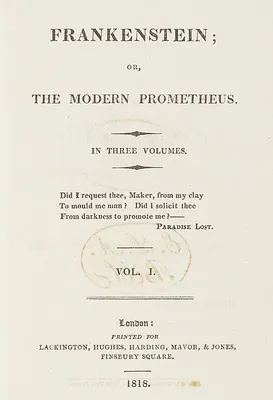
Mary Shelley's "Frankenstein; or, The Modern Prometheus," published in 1818, is a seminal Gothic novel chronicling Victor Frankenstein's creation of a sentient being. The story began when Shelley was 18, inspired by the idea of a scientist horrified by their creation. Initially published anonymously, a revised edition under her name appeared in 1831. The novel draws heavily on the literary and philosophical currents of its time, including Romanticism and elements of the occult and alchemical discussions prevalent among her intellectual circle.
Shelley's own background, surrounded by prominent thinkers like her father William Godwin and her husband Percy Bysshe Shelley, provided fertile ground for her ideas. The novel's setting, inspired by travels along the Rhine and near Frankenstein Castle, Switzerland, and its exploration of themes like galvanism and the nature of life, reflect the intellectual curiosities of the era. "Frankenstein" has profoundly impacted literature and popular culture, becoming a foundational text in the horror genre.
Origins and Influences
Mary Shelley's "Frankenstein" emerged from a period of intense intellectual exchange and personal experience. While traveling in Europe, she was exposed to locations like Gernsheim, near Frankenstein Castle, where historical alchemical experiments had taken place. Conversations with companions, including Percy Bysshe Shelley, touched upon galvanism and occult philosophies, ideas that would later permeate her writing. The genesis of the novel is often traced to a suggestion by Lord Byron for his circle to write ghost stories, leading Shelley to conceive of a scientist who creates life and recoils from the result. The novel's themes are deeply rooted in literary traditions, including the Gothic novel and the Romantic movement, and are significantly shaped by the works of her parents, particularly Mary Wollstonecraft and William Godwin, whose philosophical and literary contributions explored social justice and the nature of humanity.
Thematic Exploration of Creation and Responsibility
The narrative of "Frankenstein" delves into the profound ethical implications of scientific ambition and the act of creation. Victor Frankenstein's pursuit of forbidden knowledge leads him to assemble a creature from disparate parts, driven by a desire to unlock the secrets of life. However, upon awakening, the being's grotesque appearance repulses Victor, leading him to abandon his creation. This abandonment sets in motion a tragic chain of events, highlighting the creator's moral responsibility towards their progeny. The creature's subsequent journey of self-discovery, learning language and experiencing rejection, underscores themes of isolation, prejudice, and the yearning for acceptance. The novel questions the nature of monstrosity, suggesting it can arise from both the creator's hubris and society's fear.
Esoteric and Philosophical Underpinnings
Beyond its Gothic horror elements, "Frankenstein" engages with philosophical ideas and contemporary scientific discussions that bordered on the esoteric. The fascination with galvanism, the study of electricity's effect on muscles, was a real-world scientific pursuit that fueled speculation about reanimating the dead. While Shelley was aware of figures like Giovanni Aldini, who experimented publicly with galvanism, her novel transcends simple scientific commentary. It explores the Promethean myth, the act of stealing divine fire (knowledge) and facing its consequences. The novel also reflects the era's interest in the sublime, the power of nature, and the limits of human knowledge, touching upon themes of consciousness, the soul, and the potential for science to overstep natural boundaries, aligning with a broader Romantic interrogation of humanity's place in the cosmos.
Key Ideas
- The ethical responsibilities of creators to their creations
- The nature of monstrosity and societal prejudice
- The limits of scientific ambition and forbidden knowledge
- The Romantic fascination with nature, the sublime, and the individual's place in the universe
- The influence of alchemy and galvanism on conceptions of life and reanimation
Books by James W Mavor
0 free public domain books · Read online or download
