James G Lochtefeld
James G. Lochtefeld is a scholar whose work focuses on religion and history, particularly in India.
James G. Lochtefeld is an academic whose research interests include religious traditions and their historical development, particularly within the Indian subcontinent. His work has explored various facets of Indian religious practices and their cultural contexts. Lochtefeld's academic background provides a foundation for understanding the complexities of religious festivals and their evolution over time. He has contributed to the study of Hinduism and its associated rituals and beliefs, offering insights into their historical and social significance. His scholarship aims to provide a nuanced perspective on these traditions.
The Prayag Kumbh Mela: Origins and Evolution
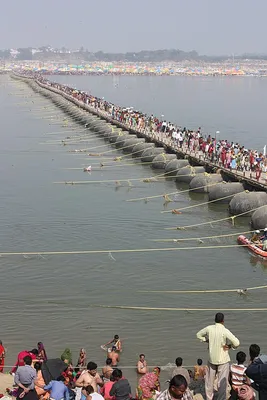
The Prayag Kumbh Mela, also known as the Allahabad Kumbh Mela, is a significant religious gathering in Prayagraj, India, held at the confluence of the Ganges, Yamuna, and the mythical Sarasvati rivers. This event is characterized by ritual bathing and also encompasses community commerce, educational activities, spiritual discourses, communal meals, and entertainment. While the full Kumbh Mela occurs every twelve years, a half-mela, or Ardh Kumbh, takes place approximately every six years. The origins of the bathing pilgrimage at Prayag at the Triveni Sangam are ancient, with mentions found in the Puranas and the Mahabharata. However, the specific designation 'Kumbh Mela' and its association with a twelve-year cycle appear to have emerged in the mid-19th century, possibly adopted by local Brahmins from traditions at Haridwar. Earlier texts, including those from Mughal historians and Bengali spiritual figures, refer to an annual Magh Mela at the site, but not the 'Kumbh Mela' with its twelve-year periodicity.
Historical Records and Early Mentions
The historical documentation of the Prayag Mela reveals a transition from an annual event to the celebrated Kumbh Mela. Early records, including those from the British East India Company, detail the annual Magh Mela, its administration, and the collection of pilgrim taxes, but do not refer to it as a 'Kumbh Mela' or highlight a twelve-year cycle. The earliest known mention of a 'Kumbh Mela' at Allahabad in contemporary sources dates to the 1870 fair. While Hindu mythology attributes the origin of the Kumbh Mela to drops of amrita falling at four sacred sites, including Prayagraj, the historical evidence suggests the twelve-year cycle and the 'Kumbh' designation were applied to the existing Magh Mela in the 19th century. This adaptation may have been influenced by other established Kumbh Mela traditions.
Mythological and Astrological Significance
According to Hindu mythology, the Kumbh Mela sites are where drops of amrita, the elixir of immortality, fell from a pot (kumbha) carried by the deity Vishnu. This mythological narrative forms the spiritual basis for the pilgrimage. The timing of the Kumbh Mela is determined by a complex calculation based on the Hindu luni-solar calendar, specifically the positions of the planet Jupiter and the sun and moon. The astrological configuration, known as Kumbh Yoga, dictates when the mela should occur. While the ideal conditions involve Jupiter's entry into specific zodiac signs and the sun and moon being in Capricorn, deviations can occur. Disagreements among Hindu astrologers about the precise astrological conjunctions have sometimes led to the celebration of fairs claimed as Kumbh Melas in successive years at the same location.
Key Ideas
- The Kumbh Mela is a major Hindu pilgrimage and festival.
- The Prayag Kumbh Mela is held at the confluence of three rivers in India.
- The festival has a twelve-year cycle, with an Ardh (half) Kumbh every six years.
- The historical evidence suggests the 'Kumbh Mela' designation and twelve-year cycle at Prayag are relatively recent, emerging in the 19th century.
- The timing of the mela is based on Hindu astrological calculations.
Books by James G Lochtefeld
0 free public domain books · Read online or download
