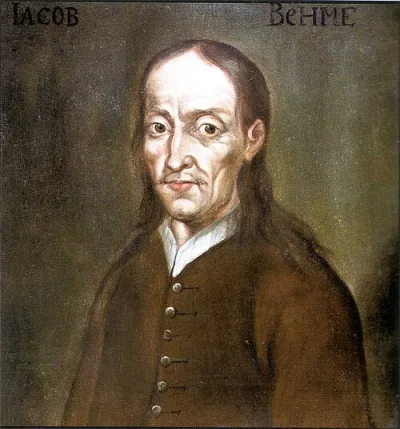
Jacob Boehme (Jakob Böhme)
Jakob Böhme was a 17th-century German mystic and philosopher whose writings explored the nature of God, evil, and redemption, influencing later thinkers.
Jakob Böhme (1575–1624) was a German philosopher, Christian mystic, and theologian from the Lutheran tradition. Despite lacking formal education, he became a master shoemaker and experienced profound mystical visions that shaped his theological and philosophical writings. His first major work, Aurora, caused significant controversy and led to his denouncement by local clergy, forcing him to cease writing for a period. He later resumed his writing, producing numerous treatises that explored complex concepts of divine essence, the fall of humanity, and the nature of good and evil.
Böhme's ideas, though sometimes diverging from strict Lutheran doctrine, offered a unique perspective on sin, redemption, and the structure of the spiritual world. His work gained a following across Europe, known as Behmenists, and profoundly influenced later philosophical movements like German idealism and Romanticism. Though his published works initially led to scandal and exile, his complete writings were eventually printed, cementing his legacy as a significant, albeit controversial, spiritual thinker.
Early Life and Mystical Awakening
Born in 1575 in Upper Lusatia, Jakob Böhme began his working life as a herd boy before apprenticing as a shoemaker. His apprenticeship exposed him to contemporary religious debates, and he pursued his spiritual studies through prayer, Bible reading, and the works of mystics like Paracelsus. Though he received no formal schooling, Böhme experienced a pivotal mystical vision in 1600, triggered by the sight of sunlight on a pewter dish. This experience, he believed, revealed the spiritual underpinnings of the universe and the relationships between God, humanity, good, and evil. He had further visionary experiences in 1610 that deepened his understanding of cosmic unity and his sense of divine calling.
Writings and Theological Controversies
Twelve years after his initial vision, Böhme began writing his first book, "Aurora," which was later named by a friend. The circulation of an early manuscript led to accusations of heresy from Görlitz's chief pastor, Gregorius Richter, who publicly denounced the work and threatened Böhme with exile. This opposition caused Böhme to pause his writing, but he resumed in 1618 at the urging of friends. He went on to author numerous treatises, including "The Three Principles of the Divine Essence" and "The Signature of All Things," which were circulated privately among his followers. In 1624, a collection of his shorter works was published as "Weg zu Christo" (The Way to Christ), reigniting controversy and leading to Böhme being summoned by the town council and warned to leave Görlitz.
Theology and Influence
Böhme's theological system primarily addressed sin, evil, and redemption, positing humanity's fall from grace and God's aim to restore the world. However, he departed from conventional Lutheranism by questioning justification by faith alone and proposing that the Fall was a necessary stage in cosmic evolution. His mystical visions informed his unique interpretations of the Trinity and the nature of God, which he described as an eternal self-regeneration. Böhme asserted that evil was not part of God's will but a consequence of a fallen state, a perversion of the original divine order. His writings, though obscure at times, profoundly impacted later philosophers and mystics, leading to the formation of the Behmenist movement.
Key Ideas
- The spiritual structure of the world and the relationship between God, humanity, good, and evil revealed through mystical vision.
- The Fall as a necessary stage in the evolution of the Universe.
- A unique interpretation of the Trinity, with God the Father as fire, the Son as light, and the Holy Spirit as divine life.
- Evil as a perversion of divine order, not an inherent part of God's will.
- The doctrine of signatures, suggesting that the physical form of things reveals their spiritual essence.
Notable Quotes
“There are as many blasphemies in this shoemaker's book as there are lines; it smells of shoemaker's pitch and filthy blacking. May this insufferable stench be far from us. The Arian poison was not so deadly as this shoemaker's poison.”
“For he that will say, I have a Will, and would willingly do Good, but the earthly Flesh which I carry about me, keepeth me back, so that I cannot; yet I shall be saved by Grace, for the Merits of Christ. I comfort myself with his Merit and Sufferings; who will receive me of mere Grace, without any Merits of my own, and forgive me my Sins. Such a one, I say, is like a Man that knoweth what Food is good for his Health, yet will not eat of it, but eateth Poison instead thereof, from whence Sickness and Death, will certainly follow.”
“[I]n the order of nature, an evil thing cannot produce a good thing out of itself, but one evil thing generates another.”
Books by Jacob Boehme (Jakob Böhme)
4 free public domain books · Read online or download