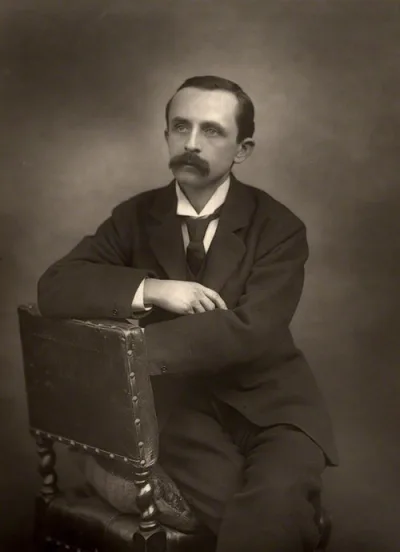
J M Barrie
J.M. Barrie, creator of Peter Pan, was a Scottish writer whose life and works explored themes of childhood, fantasy, and the passage of time.
Sir James Matthew Barrie was a Scottish novelist and playwright, most famously recognized as the creator of Peter Pan. Born in Scotland, he later moved to London, where his career flourished. His early works, influenced by his upbringing and Scottish heritage, included novels and plays that gained popularity, though they were sometimes criticized for sentimentality. Barrie's life was marked by personal loss and a deep connection with the Llewelyn Davies family, whose children inspired his most famous creation.
Peter Pan, first appearing in "The Little White Bird" and later immortalized in the play "Peter Pan, or The Boy Who Wouldn't Grow Up," became Barrie's defining work, overshadowing his other literary achievements. The play, which premiered in 1904, introduced the character of Peter Pan and the name Wendy to the world, exploring themes of eternal childhood and fantasy. Barrie continued to write successful plays, often revisiting concepts of parallel worlds and the enduring nature of childhood. He generously gifted the rights to his Peter Pan works to Great Ormond Street Hospital for Children.
Early Life and Influences
Born in Kirriemuir, Scotland, to a Calvinist family, James Matthew Barrie was the ninth of ten children. His father was a weaver, and his mother, Margaret Ogilvy, played a significant role in his life, particularly after the tragic death of his elder brother, David. Barrie's attempts to fill the void left by David and his mother's grief, coupled with her finding solace in the idea of a son who would remain a boy forever, deeply influenced his later imaginative works. His education included time at Glasgow Academy, Forfar Academy, and Dumfries Academy, where he developed a passion for reading, including popular serials and adventure novels. It was during his time at Dumfries that he and his friends would play at pirates in a garden, an experience that foreshadowed the creation of Peter Pan.
Literary Beginnings and the Rise of Peter Pan
Barrie pursued a literary career against his family's initial wishes, studying literature at the University of Edinburgh. After working as a journalist, he began writing novels based on stories about his mother's hometown, which became his first popular successes. These works, like "Auld Licht Idylls" and "The Little Minister," depicted a specific, often idealized, vision of Scottish life. However, his attention increasingly shifted to the theatre. A pivotal moment came with the inspiration drawn from the Llewelyn Davies boys, leading to the creation of Peter Pan. The character first appeared in his 1902 novel "The Little White Bird" before becoming the star of the 1904 play "Peter Pan, or The Boy Who Wouldn't Grow Up." This play, with its themes of eternal youth and the contrast between the mundane world and the fantastical Neverland, captivated audiences and became his most enduring legacy.
Later Works and Legacy
Following the immense success of Peter Pan, Barrie continued to write for the stage, producing plays like "Quality Street," "The Admirable Crichton," and "Mary Rose." Many of these later works explored complex social themes and revisited the imaginative concepts of his most famous creation, such as parallel worlds and the enduring child. Barrie's involvement in challenging theatre censorship highlighted his engagement with societal issues. He adapted the Peter Pan play into the novel "Peter and Wendy" in 1911. In a testament to his enduring affection for the characters and his concern for children's welfare, Barrie bequeathed the copyright of all Peter Pan works to Great Ormond Street Hospital for Children in London, a gift that continues to provide significant support to the institution. His final play, "The Boy David," was written in 1936.
Key Ideas
- The concept of eternal childhood and the boy who refuses to grow up.
- The contrast between mundane reality and fantastical worlds.
- Themes of loss, memory, and the enduring power of imagination.
- Social commentary through theatrical works.
Books by J M Barrie
0 free public domain books · Read online or download
