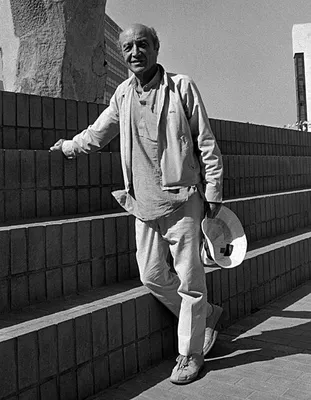
J Isamu Yamamoto
Isamu Noguchi was a versatile artist known for sculpture, landscape design, and furniture, whose early life and career were shaped by his parents and international experiences.
Isamu Noguchi, born in 1904, was an American artist whose career spanned six decades, encompassing sculpture, furniture design, and landscape architecture. His early life was marked by a complex family dynamic, with his acclaimed Japanese poet father, Yone Noguchi, and his American writer mother, Léonie Gilmour. After spending his early childhood in Japan, where he was given the name Isamu meaning "courage," he returned to the United States for schooling, sometimes known as Sam Gilmour.
Noguchi's artistic path was not immediate; initially a premedical student at Columbia University, he was influenced by figures like bacteriologist Hideyo Noguchi and dancer Michio Itō to pursue art. He apprenticed briefly with Gutzon Borglum, creator of Mount Rushmore, and later studied at the Leonardo da Vinci Art School. His early career saw him shift between abstract sculpture and portrait busts to support himself, exhibiting in New York and Paris. A Guggenheim Fellowship allowed him to study in Paris under Constantin Brâncuși, where he honed his skills in stone sculpture, and also traveled extensively through Asia, including China and Japan, studying traditional arts and crafts.
Early Life and Influences
Born in Los Angeles in 1904, Isamu Noguchi's parentage was a blend of cultures: his father was the celebrated Japanese poet Yone Noguchi, and his mother was the American writer Léonie Gilmour. His parents' relationship was tumultuous; Yone Noguchi returned to Japan before Isamu's birth and later invited Léonie and their son to join him in Tokyo in 1907. Upon arrival, Isamu was formally named, but his father, who had already married another woman, was largely absent from his childhood. Léonie and Isamu moved around Japan, and it was during this period, while living in Chigasaki, that Isamu's half-sister, Ailes Gilmour, was born. Léonie fostered Isamu's artistic inclinations, having him oversee the construction of their home and apprenticing him to a local carpenter. In 1918, Noguchi was sent to the United States for his education, attending school in Indiana and graduating from La Porte High School in 1922, during which time he used the name Sam Gilmour.
Artistic Development and International Exposure
After graduating high school, Noguchi initially pursued premedical studies at Columbia University but was drawn to art, partly due to encouragement from bacteriologist Hideyo Noguchi. He took night classes at the Leonardo da Vinci Art School and soon dropped out of Columbia to dedicate himself to sculpture full-time, adopting his father's surname, Noguchi. His early work included portrait busts commissioned by wealthy clients and participation in avant-garde art scenes. A pivotal moment came with a Guggenheim Fellowship, which enabled him to travel to Paris in 1927. There, he became an assistant to the renowned sculptor Constantin Brâncuși, learning stone carving and appreciating the "value of the moment." His time in Paris also allowed him to connect with other artists like Alexander Calder. Noguchi's travels extended to Asia, including Beijing, where he studied brush painting, and Japan, where he studied pottery and observed Zen gardens and haniwa figures, which influenced his own creations.
Navigating the Art World and Public Works
Upon returning to New York, Noguchi faced the challenges of the Great Depression, finding limited success with his abstract sculptures and Asian-inspired works. He continued to create portrait busts to sustain himself, exhibiting pieces that garnered some attention, including early set designs for Martha Graham. Noguchi also attempted to enter the realm of public art, submitting designs for monuments and public spaces, including a playground concept called "Play Mountain," which was rejected by Parks Commissioner Robert Moses. His work sometimes drew critical commentary, with one piece depicting a lynched African-American being described as "a little Japanese mistake." Despite these setbacks, he persisted in his artistic endeavors, exploring various mediums and forms throughout his career.
Key Ideas
- Appreciation of the value of the moment (learned from Brâncuși)
- Influence of Zen gardens and haniwa on sculpture
- Exploration of abstract vs. representational art for personal and financial needs
Books by J Isamu Yamamoto
0 free public domain books · Read online or download
