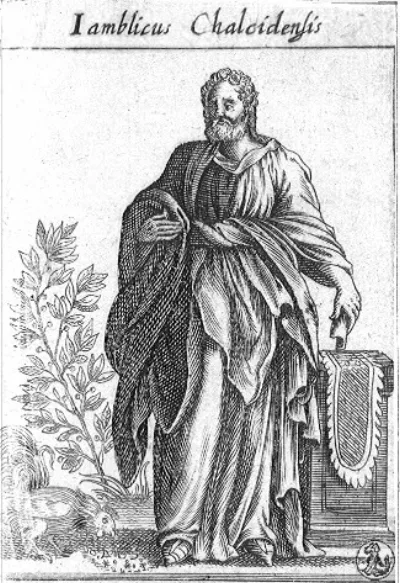
Iamblichos Alexander Wilder
Iamblichus was a Syrian Neoplatonist philosopher who significantly influenced the direction of Neoplatonism and wrote extensively on Pythagoreanism and theurgy.
Iamblichus, a Syrian philosopher of the Neoplatonic school, lived around the late 3rd and early 4th centuries CE. He was a student of Porphyry and is credited with shaping the future course of Neoplatonism. Born in Chalcis, Syria, and descended from the Emesene dynasty, Iamblichus later established his own school in Apamea. He was known for his extensive learning, charitable nature, and dedication to his students. His philosophical system integrated Pythagorean number symbolism and interpreted Neoplatonic concepts through a mythical lens. Iamblichus also explored theurgy, a practice that involved divine rituals, and engaged in significant theological discussions, including a notable divergence from his teacher Porphyry on the subject.
His philosophical contributions were extensive, building upon the foundations laid by Plotinus. Iamblichus detailed the divisions of the intellect and applied numerical symbolism more rigorously, influenced by Eastern traditions. He differed from Plotinus by reasserting the soul's connection to matter, viewing matter as divine. His cosmology featured a hierarchical system emanating from a Monad, populated by various divine entities like gods, angels, and demons. He believed these beings influenced worldly events and could be accessed through prayer and offerings. Iamblichus also proposed that numbers occupied a unique realm between the finite and infinite, and that fate governed the natural world but not the divine.
Philosophical System and Theurgy
Iamblichus significantly developed Neoplatonic thought by systematically applying Pythagorean numerical symbolism and incorporating mythical interpretations influenced by Eastern philosophies. He elaborated on Plotinus' divisions of the intellect and, unlike Plotinus, reasserted the soul's connection to matter, considering matter to be divine. His cosmology presented a hierarchical structure originating from a Monad, from which emanated the intellect (Nous) and soul (psyche). He expanded the divine hierarchy, positing numerous celestial gods, other divine beings, chiefs, and nature-gods, all of whom could influence events and communicate knowledge. Iamblichus also championed the practice of theurgy, a system of divine rituals and invocations, and engaged in debates about its efficacy, notably in his work 'On the Mysteries,' which originated from his school.
Influence and Teachings
As a prominent Neoplatonist, Iamblichus established a school in Apamea, Syria, where he developed a curriculum for studying Plato and Aristotle, and wrote commentaries on their works, though most are now lost. His supreme authority was Pythagoras, and he compiled a ten-volume work on Pythagorean doctrines, of which only fragments remain. He was highly regarded for his intellect and his charitable actions, attracting numerous students. His philosophical ideas, particularly his theological system and emphasis on theurgy, had a lasting impact on subsequent Neoplatonism and influenced fields like Christian Gnosticism. Later thinkers, such as the Roman Emperor Julian, considered him among the greatest philosophers, second only to Plato.
Notable Works and Legacy
While much of Iamblichus' extensive writings are lost, surviving fragments and the works of his successors, particularly Proclus, provide insight into his philosophy. Key surviving texts include 'On the Mysteries of the Egyptians, Chaldeans, and Assyrians' (also known as 'The Theurgia'), 'Exhortation to Philosophy' ('Protrepticus'), and 'On the Pythagorean Way of Life.' His 'Collection of Pythagorean Doctrines' was a monumental work that preserved significant philosophical traditions. Iamblichus also authored works on mathematics and commentaries on Plato. He completed a coherent polytheist theological system, sometimes attributed to the pseudonym Abammon. His influence extended through the medieval period and experienced a revival during the Renaissance.
Key Ideas
- Neoplatonic philosophy influenced by Pythagoreanism and Eastern systems
- Systematic application of number symbolism
- Mythical interpretation of Neoplatonic concepts
- Reaffirmation of the soul's embodiment in matter and divinity of matter
- Hierarchical cosmology emanating from the Monad
- Belief in a divine hierarchy (gods, angels, demons, heroes)
- Theurgy as a means of divine access
- Numbers as existing in a realm between the limited and unlimited
- Fate governs nature, but not the divine
Books by Iamblichos Alexander Wilder
0 free public domain books · Read online or download
