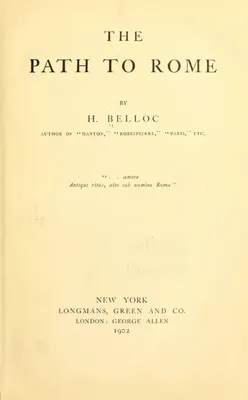
Hilaire Belloc Martin Hayes
Hilaire Belloc's "The Path to Rome" chronicles his walking pilgrimage from France to Rome, filled with observations and reflections.
Hilaire Belloc's "The Path to Rome" is a 1902 travelogue detailing his foot pilgrimage from Toul, France, to Rome. The journey was inspired by an encounter with a unique statue of Saint Mary in La Celle-Saint-Cloud, his birthplace. Belloc's account is presented in short segments, blending personal thoughts, historical and geographical commentary on the places he visited, and his own illustrations. The book is noted for its stream-of-consciousness style, incorporating dialogues with an imagined, often argumentative reader, and includes multilingual passages, songs with sheet music, and maps.
Despite the author's mother's concerns about financial stability, Belloc embarked on this pilgrimage. He made several vows for the journey, including travelling solely on foot, sleeping outdoors, maintaining a daily distance, and attending Mass daily, though he recounts breaking most of these vows except for reaching Rome in time for a specific Mass. The book became Belloc's most successful work financially, establishing his literary reputation and is considered a prime example of his travel writing. Contemporary and retrospective reviews have praised its authenticity, humour, narrative complexity, and focus on everyday details.
Narrative Style and Structure
The Path to Rome is characterized by its stream-of-consciousness style, eschewing traditional chapter divisions and dates. Belloc intersperses his narrative with numerous illustrations, musical scores for songs, and poetry. A recurring feature is his engagement with an imagined reader, referred to as 'Lector,' who is depicted as frequently argumentative and bewildered. This approach contributes to the book's unique pace, described as mirroring Belloc's own peripatetic journey. The author himself viewed the writing process as spontaneous and unburdened by rigorous research or stylistic constraints, focusing on conveying his experiences and thoughts directly and rapidly.
Genre and Literary Comparisons
While primarily categorized as a travelogue, "The Path to Rome" transcends simple genre definitions, with some critics viewing it as a form of self-portraiture where Belloc's chosen subjects reveal more about his inner world than the external locations. Its style has been described as carnivalesque, aligning with literary modernism while also anticipating postmodernist techniques. The work has drawn favorable comparisons to the literary traditions of François Rabelais and Laurence Sterne, noted for its complex narrative structures such as metalepsis, embedded narratives, and defamiliarization. The book's focus on the minutiae of daily life encountered in the towns along his route has been a significant point of critical acclaim.
Background and Motivation
Hilaire Belloc, a French-English historian and author, was deeply religious, ardently defending the Catholic faith. Born in France, he later settled in England. His decision to undertake the pilgrimage to Rome was prompted by a profound spiritual experience with a statue of Saint Mary. Despite financial pressures and his mother's objections, Belloc committed to the journey, viewing it as a spiritual and literary undertaking. He outlined five specific vows for his pilgrimage, aiming to imbue the journey with sanctity, though he acknowledges not adhering to all of them throughout its course.
Key Ideas
- Pilgrimage as a transformative journey
- The intersection of personal reflection and historical/geographical observation
- Stream-of-consciousness narrative technique
- The role of faith and vows in travel
- Literary experimentation anticipating postmodernism
Notable Quotes
“the only book I ever wrote for love”
“so extraordinary and so different from all I had seen before, so much the spirit of my valley”
“whatever occurs to me to write [...] décousu and written anyhow of its essence”
“the narrative pace [of] Belloc's wandering feet”
“This Path to Rome is a jolly book to write. No research, no bother, no style, no anything. I just write straight ahead as fast as I can and stick in all that comes into my head.”
Books by Hilaire Belloc Martin Hayes
0 free public domain books · Read online or download
