Helen J Haberly
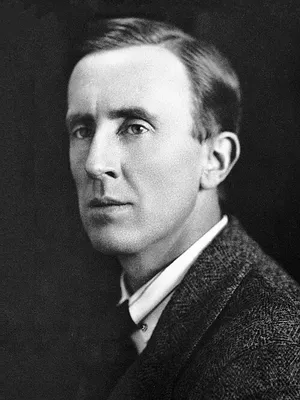
J.R.R. Tolkien was an English writer, philologist, and academic, best known for his influential fantasy works.
John Ronald Reuel Tolkien was an English writer and philologist, recognized globally for his seminal high fantasy novels, "The Hobbit" and "The Lord of the Rings." He held esteemed academic positions at the University of Oxford for decades, serving as the Rawlinson and Bosworth Professor of Anglo-Saxon and later the Merton Professor of English Language and Literature. A devout Catholic, Tolkien was also part of the Inklings, a literary discussion group, and a close friend of C.S. Lewis.
His literary contributions, particularly "The Hobbit" and "The Lord of the Rings," sparked a significant resurgence of interest in the fantasy genre, earning him the title "father" of modern fantasy literature. Posthumously, works compiled from his extensive notes, such as "The Silmarillion," further expanded his created world of Arda and Middle-earth, which he referred to as his "legendarium."
Early Life and Influences
Born in South Africa, J.R.R. Tolkien's family soon returned to England, settling in Birmingham. His mother provided his early education at home, fostering his love for languages and nature. He developed a keen interest in drawing landscapes and learned Latin from his mother. Tolkien's childhood was marked by the early death of his father and later, his mother, who converted to Catholicism, leading to financial hardship and her own early death. He and his brother were placed under the guardianship of Father Francis Xavier Morgan, who ensured they were raised as Catholics. This period shaped his strong faith and provided him with early lessons in charity and forgiveness.
Academic Career and Literary Beginnings
Tolkien pursued higher education at Exeter College, Oxford, initially studying classics before shifting to English language and literature, graduating with honors. His academic career was deeply intertwined with his passion for languages; he held significant professorships at Oxford, focusing on Anglo-Saxon and English Language and Literature. During his youth, he engaged with constructed languages and formed a literary society called the T.C.B.S. with friends, which solidified his commitment to writing poetry. His travels, including a significant trip to Switzerland, provided inspiration for his later fictional landscapes.
Philology and Invented Languages
A central aspect of Tolkien's intellectual life was his profound expertise in philology, the study of language in historical sources. This academic discipline directly informed his creation of intricate fictional languages, such as Quenya and Sindarin, for his Middle-earth legendarium. His early engagement with constructed languages like Animalic, Nevbosh, and Naffarin, as well as Esperanto, demonstrates a lifelong fascination with linguistic creation. This deep understanding of language structure and evolution was fundamental to the depth and realism of his invented worlds and narratives.
Key Ideas
- Legendarium: A term Tolkien used for the collective body of his writings concerning Arda and Middle-earth.
- Father of Modern Fantasy: Popular identification due to the impact of his works on the fantasy genre.
Notable Quotes
“My own dear mother was a martyr indeed, and it is not to everybody that God grants so easy a way to his great gifts as he did to Hilary and myself, giving us a mother who killed herself with labour and trouble to ensure us keeping the faith.”
Books by Helen J Haberly
0 free public domain books · Read online or download
