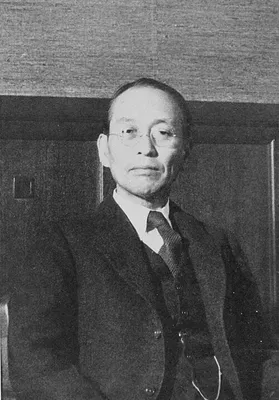
Hachiro Asano
Saishū Onoe was a Japanese tanka poet, educator, and calligrapher known for founding the Shazensō-sha society.
Saishū Onoe, born Hachirō Onoe, was a prominent Japanese figure in tanka poetry, education, and calligraphy. After graduating from Tokyo Imperial University in 1901, he embarked on a career in academia, teaching at institutions including Ochanomizu Women's College and Waseda University. His influence extended to Gakushuin Women's University and a vocational teacher training school. Onoe also contributed to the magazine Shinsei with a poetry column. In 1905, he established the Shazensō-sha, or "Plantain Society." This group emphasized clarity, simplicity, and the depiction of everyday experiences in poetry, serving as a counterpoint to the more passionate style prevalent in the Myōjō magazine circle. Notable poets like Wakayama Bokusui and Maeda Yūgure, who was Onoe's student, were associated with Shazensō-sha. Onoe was also an avid collector of historical calligraphy. He received the Second Order of the Sacred Treasure in 1939 and passed away on January 1, 1957. Posthumous exhibitions have been held to honor his work.
Poetic Philosophy and Shazensō-sha
Saishū Onoe's literary contributions extended beyond his academic career. He actively participated in the poetry scene, notably through a column in the magazine Shinsei. A significant aspect of his legacy is the founding of the Shazensō-sha, or "Plantain Society," in 1905. This society was established with a distinct philosophical approach to tanka poetry, prioritizing clarity, simplicity, and the honest portrayal of ordinary life. This emphasis stood in contrast to the prevailing style associated with the Myōjō magazine, which often focused on intense emotional expression. The Shazensō-sha attracted like-minded poets, including the Naturalist tanka poets Wakayama Bokusui and Maeda Yūgure, who was a direct pupil of Onoe Saishū. This movement highlights Onoe's role in shaping poetic aesthetics and fostering a community around his artistic ideals.
Educational and Calligraphic Pursuits
Beyond his poetic endeavors, Saishū Onoe was a dedicated educator and a skilled calligrapher. His academic career began after his graduation from Tokyo Imperial University, leading him to teach at various esteemed institutions. He held positions at Tetsugaku-kan, Ochanomizu Women's College (then known as Tokyo Women's Higher Normal School), and Waseda University's Department of Education. His teaching responsibilities also extended to Gakushuin for Girls and a vocational teacher training school. Onoe's expertise in calligraphy is evident through his publications, which include textbooks and historical accounts of Japanese calligraphy, co-authored with prominent figures like Tetsuji Morohashi. He also published works on Japanese calligraphy and spirit. His dedication to the art form is further underscored by his extensive collection of historical calligraphic works and the posthumous exhibitions and catalogs dedicated to his own calligraphic achievements.
Legacy and Recognition
Saishū Onoe's impact is recognized through various avenues, including exhibitions and honors. A posthumous exhibition was held in Ginza in 1957, shortly after his death. Subsequent exhibitions marked significant anniversaries of his birth, including his 100th and 130th years, in 1975 and 2006 respectively, with accompanying catalogs published to document his work. These exhibitions, held at venues like the Tokyo Central Art Museum and Naritasan Temple Calligraphy Museum, underscore his enduring influence. In addition to these public recognitions, Onoe received the Second Order of the Sacred Treasure on April 23, 1939, acknowledging his contributions. His work as a collector of historical calligraphic pieces, including sutras, also adds another dimension to his multifaceted legacy.
Key Ideas
- Emphasis on clarity, simplicity, and capturing ordinary experiences in poetry.
- Poetic style as a reaction against the passionate expression in tanka poetry of the Myōjō magazine circle.
Books by Hachiro Asano
2 free public domain books · Read online or download