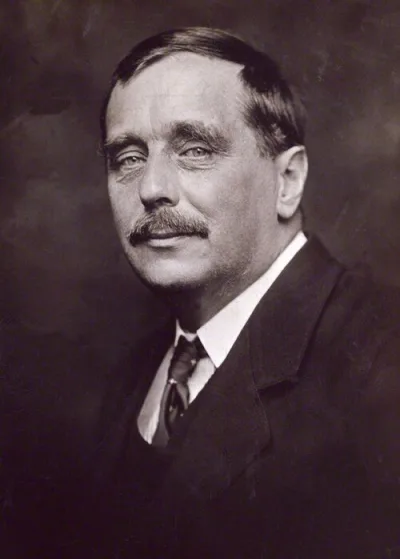
H G Wells
H. G. Wells was a prolific English writer, known for pioneering science fiction and offering prophetic social commentary.
Herbert George Wells, born in 1866, was an influential English writer whose extensive work spanned numerous genres, including novels, short stories, and non-fiction on social commentary, politics, history, and popular science. He is primarily celebrated today for his foundational science fiction, often earning him the title "father of science fiction." Beyond his literary achievements, Wells was a prominent social critic and futurist, envisioning advancements like aircraft, space travel, and nuclear weapons, and exploring concepts such as time travel and alien invasions in his fiction.
Wells's writing style was noted for its realism, grounding extraordinary assumptions in commonplace detail, a technique lauded by contemporaries. While recognized for social realist novels depicting lower-middle-class life, his broader social analysis, as seen in works like Tono-Bungay, aimed to diagnose English society. His early scientific training in biology influenced his thinking, and he was an early advocate for socialist ideals and eugenics, though he later recanted some of these views. Wells also co-founded The Diabetic Association.
Literary Innovations and Social Vision
H. G. Wells distinguished himself as a pioneer in science fiction, a genre he helped shape with groundbreaking novels. He possessed a unique ability to make his fantastical narratives believable by grounding them in everyday details, a method Joseph Conrad famously termed "Wells's law." This approach, combined with his imaginative leaps, led to works that explored themes like time travel, extraterrestrial encounters, and biological manipulation before they became commonplace in speculative fiction. Beyond his imaginative tales, Wells was a keen social critic and futurist. He used his literary talents to advocate for progressive social change and a global vision, accurately predicting many technological advancements that would shape the future.
Early Life and Educational Influences
Born in 1866, Herbert George Wells experienced a childhood marked by financial hardship and a significant leg injury that led him to discover the power of reading. This early immersion in literature sparked his desire to write. His formal education was varied, including an unhappy apprenticeship as a draper, which later informed his social realist novels. A pivotal period was his scholarship to study biology under T. H. Huxley, where he developed a scientific worldview that influenced his ethical and social thinking. During this time, he engaged with socialist ideas and contributed to a school journal, publishing early versions of his speculative fiction.
Philosophical and Social Stances
Wells's intellectual development was significantly shaped by his biological studies and a Darwinian context, influencing his views on ethics and society. He was an early and vocal socialist, often aligning with pacifist sentiments, though this was not consistent, particularly at the outset of World War I. In his adult life, he was a prominent proponent of eugenics and involuntary euthanasia, advocating for measures he believed necessary for socialist progress, although he largely disavowed these positions later in life. His later writings focused more on expounding his political and social theories, reflecting a shift from fiction to direct social commentary.
Key Ideas
- Grounding extraordinary assumptions in commonplace detail ('Wells's law')
- Futuristic social commentary and prediction
- Exploration of time travel, alien invasion, invisibility, and biological engineering
- Social realist depictions of lower-middle-class life
- Diagnoses of English society
- Eugenics and involuntary euthanasia (later recanted)
Notable Quotes
“O Realist of the Fantastic!”
Books by H G Wells
0 free public domain books · Read online or download
