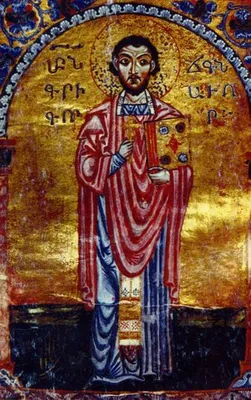
Grigor Narekatsʻi, Saint, Grigor Narekatsi, Thomas Samuelian
Grigor Narekatsi was a revered Armenian monk, poet, and theologian known for his mystical writings, particularly the Book of Lamentations.
Grigor Narekatsi, an Armenian monk, theologian, and poet, lived around the 10th century and is celebrated for his profound mystical and lyrical contributions. Born near Lake Van, he received his education at the Narekavank monastery from his great-uncle, a noted scholar. Ordained a priest, he became a significant figure in Armenian religious and literary traditions. His life and teachings have been interpreted in various ways, with some scholars debating the extent of his engagement with the secular world versus a more secluded existence.
Narekatsi is best known for his "Book of Lamentations," a collection of prayers and meditations that explores the human struggle for perfection and unworthiness in the face of divine grace. This work has become a cornerstone of Armenian spiritual literature, often kept in homes and regarded with deep reverence, sometimes attributed with miraculous properties. His other significant writings include a commentary on the Song of Songs and various hymns and encomia, often defending orthodox beliefs against dissenting sects like the Tondrakians. He was officially recognized as a Doctor of the Church by Pope Francis in 2015.
Mystical Poetry and Theology
Grigor Narekatsi is primarily recognized for his deeply spiritual and mystical literary output. His most celebrated work, the "Book of Lamentations," is a profound collection of prayers that delves into the complex relationship between humanity's inherent imperfection and the boundless mercy of God. This work, comprising 95 chapters, is seen as a confessional and meditative text, grappling with existential conflicts and the desire for divine perfection. Narekatsi's theological perspectives, while rooted in Armenian tradition, have been noted for their emphasis on faith and divine grace, leading some to draw parallels with later Protestant thought. His philosophical outlook appears influenced by Neoplatonism, contributing to concepts like divinization within Armenian theology.
Literary Legacy and Influence
The "Book of Lamentations" is considered the pinnacle of Narekatsi's literary achievements and a masterpiece of Armenian literature, often holding a place of honor second only to the Bible in Armenian households. Its enduring popularity is evidenced by centuries of veneration and the attribution of healing powers to its passages. Beyond this seminal work, Narekatsi authored a significant commentary on the Song of Songs, where he addressed theological controversies of his time, particularly condemning the practices of the Tondrakian sect. He also composed hymns, prayers, and encomia, including those affirming key Marian doctrines. His innovative style in these works departed from traditional Armenian and Greek forms, leaving a lasting impact on Armenian literature and religious thought.
Life and Background
Born in the Kingdom of Vaspurakan, a region known for its high cultural achievements, Grigor Narekatsi's early life was shaped by his father, Khosrov Andzevatsi, a bishop with theological views that led to his excommunication. Grigor and his brother were sent to the Narekavank monastery, where he received religious instruction from his maternal great-uncle, Anania Narekatsi, the monastery's founder. Narekatsi was ordained a priest in 977 and dedicated himself to teaching theology at the monastery school. While some scholars suggest he led a secluded life, others argue he possessed a deep understanding of the secular world. His tomb was located within the Narek monastery, which was later destroyed.
Key Ideas
- The conflict between the human desire for perfection and the realization of unworthiness.
- The compensating power of God's all-embracing, forgiving, and amazing grace.
- Eternal salvation achieved through faith and divine grace, potentially independent of institutional church structures.
- The centrality of sacraments like baptism, reconciliation, and Eucharist.
- Neoplatonic influences, including concepts of divinization and spiritual discernment.
Books by Grigor Narekatsʻi, Saint, Grigor Narekatsi, Thomas Samuelian
2 free public domain books · Read online or download