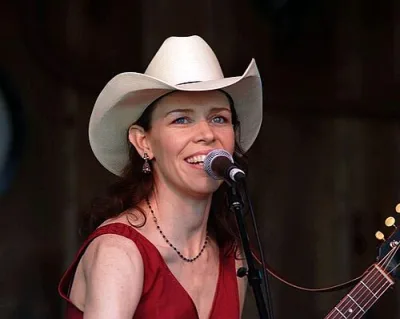
Gillian Kemp
Gillian Welch is an American singer-songwriter known for her roots-inspired music and collaborations with David Rawlings.
Gillian Welch, born October 2, 1967, is an American singer-songwriter recognized for her distinctive musical style, often characterized by its spare, dark sound that blends Appalachian, bluegrass, country, and Americana influences. She primarily collaborates with guitarist David Rawlings, and together they have released critically acclaimed albums. Welch's debut album, 'Revival' (1996), garnered significant attention and a Grammy nomination. Subsequent releases, including 'Time (The Revelator)' and 'The Harrow & the Harvest,' also received critical praise and award nominations. Her work has been featured in significant cultural projects, such as the soundtrack for the Coen brothers' film 'O Brother, Where Art Thou?', and she co-wrote a song for 'The Ballad of Buster Scruggs,' earning an Academy Award nomination.
Welch's musical journey began with an early exposure to folk music, leading her to explore various genres before discovering her passion for bluegrass. After studying songwriting at Berklee College of Music, she moved to Nashville and formed her enduring partnership with David Rawlings. Their collaborative approach emphasizes minimal instrumentation and a focus on vocal harmonies and lyrical depth. Welch has also established her own independent label, Acony Records, to release her music. Her artistic output is notable for its consistent exploration of traditional sounds while maintaining a unique and contemporary voice.
Early Life and Musical Awakening
Gillian Welch was born in New York City on October 2, 1967, and was adopted by entertainers Mitzie and Ken Welch. Her adoptive parents' careers in comedy and music exposed her to various artistic influences. During her childhood, she was introduced to the music of prominent American folk singers like Bob Dylan and Woody Guthrie. While attending college at the University of California, Santa Cruz, a pivotal moment occurred when she heard the bluegrass band The Stanley Brothers. This experience profoundly impacted her, leading her to discover what she described as 'my music.' After graduating with a degree in photography, she pursued songwriting at Berklee College of Music, where she met her longtime musical partner, David Rawlings.
Artistic Style and Collaboration
Welch's music, often created in partnership with David Rawlings, is characterized by its sparse, sometimes dark, and deeply resonant sound. Critics have noted its blend of Appalachian, bluegrass, country, and Americana elements, with the New Yorker describing it as 'at once innovative and obliquely reminiscent of past rural forms.' Their collaborative process typically favors minimal instrumentation, focusing on the interplay of their voices and guitars. This approach has been consistent throughout their nine critically acclaimed albums. Welch also founded her own independent label, Acony Records, allowing for greater creative control over her releases. Her work has been recognized with multiple Grammy Award nominations and wins, solidifying her reputation as a significant artist in roots music.
Notable Contributions and Recognition
Beyond her album releases, Gillian Welch has made notable contributions to film soundtracks. She was an associate producer and performer on the soundtrack for the Coen brothers' 2000 film 'O Brother, Where Art Thou?', an album that achieved platinum status and won a Grammy for Album of the Year. She also contributed vocals and additional lyrics to the song 'Didn't Leave Nobody but the Baby' for the film. In 2018, she and Rawlings penned 'When a Cowboy Trades His Spurs for Wings' for the Coens' 'The Ballad of Buster Scruggs,' earning them an Academy Award nomination for Best Original Song. Her songs have also been covered by numerous other artists, including Emmylou Harris and Linda Ronstadt.
Notable Quotes
“The first song came on and I just stood up and I kind of walked into the other room as if I was in a tractor beam and stood there in front of the stereo. It was just as powerful as the electric stuff, and it was songs I'd grown up singing. All of a sudden I'd found my music.”
“I looked at my record collection and saw that all the music I loved had been made in Nashville—Bill Monroe, Dylan, the Stanley Brothers, Neil Young—so I moved there. Not ever thinking I was thirty years too late.”
“That first week was really intense. It was just T Bone, the engineer, and Dave and myself. We got so inside our little world. There was very little distance between our singing and playing. The sound was very immediate. It was so light and small.”
Books by Gillian Kemp
5 free public domain books · Read online or download