Gerald del Campo
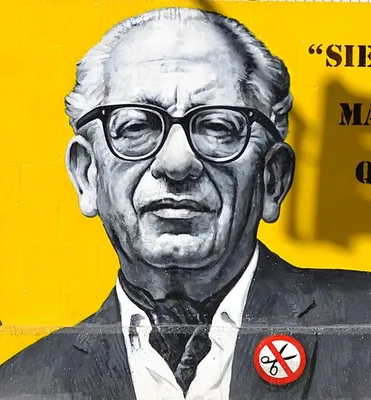
Max Aub was a prolific Mexican-Spanish writer, critic, and cultural figure who navigated war, exile, and political upheaval.
Born in Paris in 1903 to a French mother and German father, Max Aub's life was shaped by early displacement. Following his father's business in Spain at the onset of World War I, the family became Spanish citizens. Aub spent his youth in Valencia, completing his education and embarking on a career as a traveling salesman across Europe. He joined the Spanish Socialist Workers' Party in 1929 and remained a member throughout his life.
Aub's involvement in Spanish politics deepened during the Civil War, where he served as a cultural attaché for the Republican government in Paris. He played a role in exhibiting Picasso's "Guernica" and organizing anti-fascist writers' congresses. His artistic contributions extended to film, including work on André Malraux's "L'espoir." The war's aftermath led to his exile, facing denunciation and imprisonment in France before escaping to Mexico, where he established a new life as a screenwriter, journalist, and professor, becoming a Mexican citizen in 1955. He died in Mexico City in 1972.
Early Life and Political Awakening
Max Aub Mohrenwitz was born in Paris in 1903. His family's circumstances, involving his father's German nationality and business travels, led them to Spain at the start of World War I, where they eventually adopted Spanish citizenship. Aub's formative years were spent in Valencia, culminating in his secondary education. He followed his father into sales, traveling extensively throughout Europe between 1920 and 1935. A significant political commitment began in 1929 when he joined the Spanish Socialist Workers' Party, a political affiliation he maintained for the rest of his life. His literary career began to take shape during this period, with early publications appearing in notable journals.
The Spanish Civil War and Cultural Diplomacy
During the tumultuous Spanish Civil War, Max Aub served the Republican cause from Paris as a cultural attaché. His responsibilities included facilitating the public display of Picasso's iconic "Guernica" at the International Exposition and participating in the organization of the Second Congress of Anti-Fascist Writers. Returning to Spain, he took on a leadership role as the general secretary of the Consejo Central de Teatro. His engagement with the arts extended to film, as he contributed to André Malraux's cinematic project "L'espoir," writing its screenplay.
Exile and Post-War Life
The end of the Spanish Civil War marked the beginning of Max Aub's lengthy exile. Fleeing Spain in 1939, he was subsequently targeted by the Vichy government in France, denounced as a communist and of Jewish heritage, leading to his imprisonment in Camp Vernet and later deportation to a forced labor camp in Algeria. He managed a daring escape in 1942, aided by Mexican consul Gilberto Bosques, and eventually found passage to Mexico. In Mexico, Aub reintegrated into artistic and intellectual circles, forming friendships with fellow Spanish exiles like Luis Buñuel. He pursued a career as a screenwriter, contributed to major newspapers, and taught at the Film Academy, becoming a naturalized Mexican citizen in 1955. He remained in Mexico City until his passing in 1972.
Literary Output
Max Aub was an exceptionally prolific writer, authoring nearly one hundred novels and plays, though only a fraction of his work has been translated into English. His most significant literary achievement is the expansive novel cycle "El laberinto mágico" (The Magic Labyrinth), a multi-volume work dedicated to exploring the Spanish Civil War, written over a span of twenty-five years. This cycle includes titles such as "Campo Cerrado" (translated as "Field of Honour") and "Campo abierto," alongside numerous short stories. Despite his considerable reputation in Spain, his translated works remain limited, offering English-speaking readers a glimpse into his vast literary universe.
Books by Gerald del Campo
3 free public domain books · Read online or download