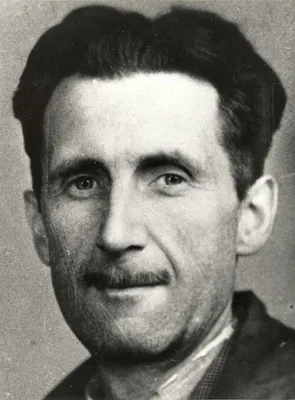
George Orwell
George Orwell, born Eric Arthur Blair, was an English writer known for his sharp social criticism and anti-totalitarian stance.
Eric Arthur Blair, who wrote under the pen name George Orwell, was an English novelist, poet, essayist, journalist, and critic. His writing is recognized for its clear prose and its strong opposition to totalitarianism, encompassing both authoritarian communism and fascism, while also advocating for democratic socialism. Orwell achieved widespread recognition for his allegorical novella "Animal Farm" and the dystopian novel "Nineteen Eighty-Four." However, his literary output also included significant contributions to literary criticism, poetry, fiction, and journalism.
Beyond his fiction, Orwell's non-fiction works are highly regarded. "The Road to Wigan Pier" documented his experiences within industrial working-class life in northern England, and "Homage to Catalonia" recounted his involvement in the Spanish Civil War fighting for the Republican faction. His essays, which explored themes of politics, literature, language, and culture, are considered equally important. The enduring influence of Orwell's work is evident in popular and political culture, with the term "Orwellian" now a common descriptor for authoritarian social practices. Many of his coined phrases, such as "Big Brother" and "Thought Police," have become integrated into the English language.
Early Life and Education
Born Eric Arthur Blair in British India in 1903, Orwell came from a family he described as "lower-upper-middle class." His lineage included a wealthy slave-owning ancestor and a grandfather who was an Anglican clergyman. His father worked in the Indian Civil Service, overseeing opium production. Orwell's mother, who grew up in Burma, brought him and his sister to England when he was an infant. He was educated in England, attending St Cyprian's School and later Wellington and Eton College, where he received scholarships. Despite a challenging experience at St Cyprian's, which he later wrote about, he developed friendships and early literary interests. His time at Eton, though marked by reports of neglected studies, involved participation in college publications and the Eton Wall Game. Unable to afford university without further scholarship, and with poor academic results, his family decided he should join the Imperial Police.
Policing in Burma and Literary Beginnings
In 1922, Blair joined the Indian Imperial Police, choosing a posting in Burma, then a part of British India. He served as an Assistant District Superintendent, gaining significant responsibility early in his career. His duties involved overseeing large populations and maintaining security in various districts. He experienced hostility from the Burmese population and struggled with his role within the empire. During his service, he adopted a pencil moustache and tattoos on his knuckles, which he noted were believed by some Burmese to offer protection. He developed a reputation as an outsider, spending time alone, reading, and engaging with local culture. After contracting dengue fever in 1927, he took leave in England, where he decided to resign from the police force to pursue a career as a writer. His experiences in Burma later informed his novel "Burmese Days" and essays like "A Hanging."
Key Ideas
- Opposition to totalitarianism (communism and fascism)
- Support of democratic socialism
- Lucid prose
- Social criticism
Books by George Orwell
0 free public domain books · Read online or download
