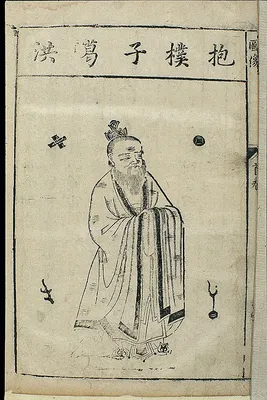
Ge Hong
Ge Hong was a 4th-century Chinese polymath known for his work in alchemy, medicine, and Taoist philosophy.
Ge Hong, born in 283 AD, was a prominent Chinese scholar and official during the Eastern Jin dynasty. His life spanned a period of significant intellectual and social change, and he made contributions across multiple fields including linguistics, philosophy, medicine, and politics. Despite his family's decline, Ge Hong pursued knowledge diligently, often overcoming material hardships by borrowing books and copying them himself. He displayed an ascetic nature, valuing spiritual guidance over worldly gain and classical literature alone. His philosophical leanings leaned towards Taoism, particularly its pursuit of immortality and alchemical practices, though he did not reject Confucianism.
Ge Hong's career saw him hold various official and military positions, but he often found himself dissatisfied with public life, preferring periods of seclusion. During these times, he dedicated himself to studying and practicing alchemy, gathering herbs, and refining elixirs. He also meticulously documented medical knowledge, including folk remedies and his own research, leading to influential medical texts. His work on alchemy and medicine, particularly his experimental approach and emphasis on innovation, left a lasting impact on subsequent generations, influencing fields from traditional Chinese medicine to modern pharmaceutical discoveries.
Philosophical and Alchemical Pursuits
Ge Hong's intellectual life was deeply influenced by Taoist philosophy and the pursuit of alchemical arts. He adopted the name Baopuzi, meaning 'embracing simplicity,' reflecting a core tenet of his philosophy: a commitment to fundamental virtues, unadorned truth, and a detachment from material desires. While serving in official capacities, he grew increasingly drawn to Taoist cultivation and the search for elixirs that could lead to spiritual immortality. His studies in alchemy were extensive, learning from masters like Zheng Yin and Bao Liang, and he also received the influential text Sanhuangjing. He married Bao Gu, who was skilled in moxibustion, further integrating his personal life with his esoteric interests. Ge Hong's writings, particularly the Baopuzi, explored these themes, seeking a synthesis of Confucian principles and Taoist practices.
Contributions to Medicine and Science
Beyond his philosophical explorations, Ge Hong made significant advancements in medicine and demonstrated a keen scientific mind. He is credited as an originator of first aid in traditional Chinese medicine and compiled extensive medical knowledge in works like the Emergency Formulae at an Elbow's Length. This text contained practical remedies, including suggestions for treating rabies with brain matter from rabid dogs and using Artemisia annua for malaria, a discovery that later inspired Nobel Prize-winning research. Ge Hong also engaged in empirical observation and experimentation in chemistry, documenting chemical reactions such as the redox reaction of mercury and the transformation of copper sulfate into a bronze-like alloy. His approach emphasized innovation and experimental results, questioning traditional reliance solely on ancient texts.
Life and Career
Born into a respected family in 283 AD, Ge Hong's early life was marked by his father's death when he was thirteen, leading to his family's decline. He experienced hardship, pursuing education by borrowing books and working to afford writing materials. Despite this, he rose through the bureaucracy, holding various governmental and military posts. However, he often expressed dissatisfaction with official life, finding more fulfillment in periods of seclusion where he could focus on his studies and practices. He sought positions that would allow him access to cinnabar, a key ingredient in alchemical elixirs, and spent time in places like Mount Luofu refining his techniques. His later writings, including his autobiography, reflect his perspective on the transient nature of honor and status.
Key Ideas
- Pursuit of Taoist immortality through alchemy and spiritual cultivation
- Emphasis on simplicity, fundamental virtues, and detachment from material wealth
- Integration of Confucianism and Taoism
- Experimental approach to medicine and alchemy, valuing innovation over traditionalism
- Originator of first aid concepts in traditional Chinese medicine
Notable Quotes
“Honor and status, are like guests yet are not common goods, as they leave they cannot be kept.”
Books by Ge Hong
0 free public domain books · Read online or download
