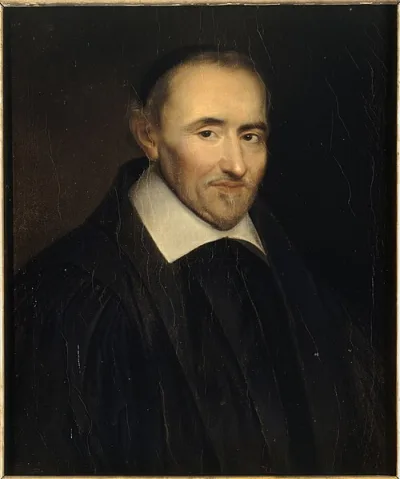
Gassendi, Pierre.
Pierre Gassendi was a French philosopher, priest, and scientist who sought to reconcile Christian doctrine with Epicurean atomism.
Pierre Gassendi was a French philosopher, Catholic priest, astronomer, and mathematician who lived from 1592 to 1655. While holding a church position, he also spent significant time in Paris, becoming a leader among free-thinking intellectuals. Gassendi was an active observational scientist, notably publishing the first data on the transit of Mercury in 1631. His philosophical work aimed to bridge skepticism and dogmatism, and he is recognized as one of the first to articulate a modern "scientific outlook" based on moderated skepticism and empiricism. He famously engaged in intellectual debates with contemporaries like Descartes concerning the possibility of certain knowledge. A central intellectual project for Gassendi was his attempt to harmonize the atomistic philosophy of Epicurus with Christian teachings.
Philosophical Contributions and Scientific Endeavors
Gassendi's philosophical contributions are marked by his effort to find a middle ground between extreme skepticism and rigid dogmatism. He is credited with formulating a "scientific outlook" that blended moderated skepticism with empirical observation. This approach led him to engage in significant intellectual debates, most notably with René Descartes, regarding the nature and certainty of knowledge. A core focus of his philosophical endeavors was the ambitious project of reconciling the atomistic theories of Epicurus with the tenets of Christianity, a challenging synthesis for his time. His scientific work included pioneering observations, such as publishing the first data on the transit of Mercury in 1631, and he was also involved in astronomical calculations and the study of physical phenomena.
Reconciling Ancient Philosophy with Christianity
A significant aspect of Pierre Gassendi's intellectual legacy lies in his attempt to revive and reinterpret ancient philosophical systems within a Christian framework. His most notable effort in this regard was his project to reconcile Epicurean atomism with Christian doctrine. This involved a deep engagement with the works of Epicurus, leading to extensive commentaries and syntheses. Gassendi sought to demonstrate that atomism, when properly understood and integrated, did not necessarily contradict fundamental Christian beliefs. This endeavor positioned him as a unique figure who navigated the complex intellectual landscape of the 17th century, seeking to bridge seemingly disparate philosophical and theological traditions.
Scientific Observations and Methodological Innovations
Beyond his philosophical work, Gassendi made notable contributions to the scientific advancements of his era. He was an advocate for empirical methods and conducted various scientific observations and experiments. He is recognized for explaining parhelia through ice crystals and for being the first to observe the transit of Mercury across the Sun in 1631. Gassendi also utilized the camera obscura to measure the Moon's apparent diameter and conducted experiments related to momentum and the speed of sound. His work on the possibility of a vacuum, influenced by Pascal's experiments, and his defense of atomism, following Epicurus, further underscore his commitment to observational science and empirical reasoning.
Key Ideas
- Reconciliation of Epicurean atomism with Christianity
- Formulation of a "scientific outlook" blending skepticism and empiricism
- Debate on the possibility of certain knowledge with Descartes
- Explanation of scientific phenomena through empirical observation
Books by Gassendi, Pierre.
0 free public domain books · Read online or download