Gabriel Raphael
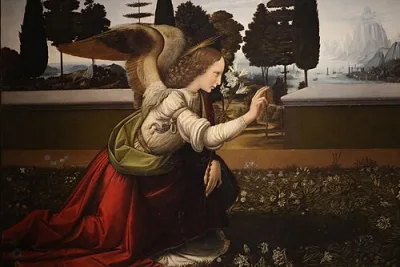
Gabriel is an archangel prominent in Abrahamic religions, known as God's messenger and interpreter of divine will.
Gabriel is a significant archangel across Judaism, Christianity, and Islam, primarily recognized as God's messenger. In Jewish tradition, he appears in the Hebrew Bible, notably in the Book of Daniel, where he explains visions. Later Jewish writings, like the Book of Enoch, elevate him to archangel status and assign him roles in cosmic battles and divine judgment. Rabbinic Judaism places him as one of four archangels guarding God's throne, often serving beneath Michael but executing God's will on Earth. Mystical Judaism associates Gabriel with the sefira of Yesod and the transmission of souls.
In Christianity, Gabriel's most famous New Testament appearances are in the Gospel of Luke, announcing the births of John the Baptist and Jesus to Zechariah and Mary, respectively. He is revered as a saint in many Christian denominations. Early Christian non-canonical texts and Gnostic writings also feature Gabriel, sometimes as a divine being within a larger spiritual hierarchy. The Church of Jesus Christ of Latter-day Saints identifies Gabriel with the biblical figure Noah. His feast day is traditionally celebrated on March 18th.
Islam regards Gabriel (Jibril) as a principal archangel who delivered the Quranic revelations to Muhammad. He is associated with divine communication and is central to the transmission of God's word. Across these faiths, Gabriel's name, often interpreted as 'man of God' or 'strength of God,' reflects his role as a divine intermediary and herald.
Role as Divine Messenger and Interpreter
Gabriel's primary function across Abrahamic religions is that of a divine messenger, conveying God's will and pronouncements to humanity. In the Hebrew Bible, he appears to the prophet Daniel to interpret complex visions, a role that establishes him as a key revealer of divine knowledge. This function extends into later Jewish literature, where he continues to explain prophecies and cosmic events. In Christianity, his annunciations to Zechariah and Mary in the Gospel of Luke are pivotal moments, marking the beginning of the events leading to Jesus' birth. Islamic tradition similarly venerates Gabriel as the archangel who transmitted the Quranic verses to the Prophet Muhammad, solidifying his image as the conduit for God's most important messages.
Hierarchical and Cosmic Significance
Within the celestial hierarchy described in various traditions, Gabriel often holds a prominent position. While not explicitly called an archangel in the Hebrew Bible, he is described as such in intertestamental Jewish writings like the Book of Enoch, where he is listed among a council of holy angels and is tasked with combating fallen spirits. Rabbinic Judaism places him as one of the four archangels attending God's throne, serving at God's left hand and ranking below Michael, but still a significant angelic authority. In Kabbalistic literature, he is associated with the sefira of Yesod, representing foundation and connection. His role is often depicted in conjunction with Michael, suggesting a partnership in divine administration and protection, particularly for the Israelites.
Interpretations of Name and Nature
The name Gabriel itself carries theological weight, derived from Hebrew roots meaning 'man of God' or 'strength of God.' This etymology is seen as prefiguring his divine mission, particularly his role in announcing the dual nature of Jesus as both human and divine, as suggested by early Christian writers like Proclus of Constantinople. Saint Bernard further interpreted his name as 'strength of God,' linking it to his function in announcing Christ's power and virtue. While depicted with wings like other angels, Gabriel typically assumes a human form when interacting with mortals. Mystical traditions sometimes associate him with specific elements, such as the metal gold, symbolizing divine fire or purity.
Gabriel in Esoteric and Non-Canonical Traditions
Beyond mainstream religious texts, Gabriel appears in various esoteric and non-canonical writings. The Book of Enoch extensively details his involvement in cosmic events, including the judgment of fallen angels. Early Christian pseudepigrapha and Gnostic texts also feature Gabriel, sometimes portraying him as a significant spiritual entity within complex cosmologies that predate or exist alongside conventional doctrines. In Gnosticism, he might be depicted as a being from the Pleroma, existing before the material world's creation. The Church of Jesus Christ of Latter-day Saints uniquely identifies Gabriel with the biblical figure Noah, viewing 'Gabriel' as Noah's heavenly name, thus linking him to a foundational figure in salvation history.
Books by Gabriel Raphael
2 free public domain books · Read online or download