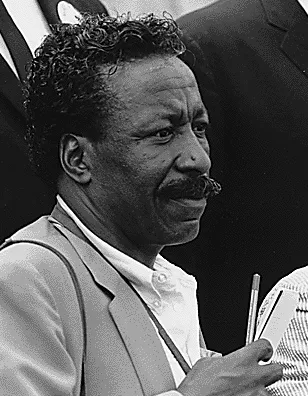
Floyd Gordon
Gordon Parks was a pioneering Black American artist, photographer, filmmaker, and writer known for his powerful portrayals of poverty, civil rights, and Black life.
Gordon Parks (1912–2006) was a multifaceted American artist, gaining prominence as a photographer, composer, author, poet, and filmmaker. He significantly contributed to U.S. documentary photojournalism from the 1940s to the 1970s, focusing on civil rights, poverty, and African American experiences, alongside his work in glamour photography. Parks is particularly remembered for his poignant 1940s photographs of impoverished Americans for a government project, his extensive photo essays for Life magazine, and his directorial work on films like 'Shaft' and 'The Learning Tree.'
As one of the first Black filmmakers to direct within the Hollywood system, Parks developed films that explored the experiences of enslaved and struggling Black Americans, contributing to the emergence of the "blaxploitation" genre. His film 'The Learning Tree' is recognized as the first feature film by a Black director financed by a major Hollywood studio. Parks's early life was marked by hardship, including attending segregated schools and facing personal loss and financial struggles, which profoundly influenced his artistic vision and his commitment to documenting social realities.
Early Life and Influences
Born in Fort Scott, Kansas, Gordon Parks was the youngest of fifteen children. His early life was shaped by segregation, economic hardship, and personal tragedy. He attended segregated schools where his aspirations for higher education were discouraged. A traumatic childhood incident involved being thrown into a river by white youths, and he experienced the death of his mother at fourteen. After her death, he moved to St. Paul, Minnesota, and eventually left home at fifteen to survive independently. During these formative years, he worked various jobs, including in brothels and as a musician, and briefly worked in an elite club where he observed societal structures and accessed a library, an experience that broadened his perspective.
Photographic Career and Social Commentary
Parks discovered photography in his late twenties, purchasing his first camera and teaching himself the craft. His early work in Chicago, focusing on the African American community, earned him a fellowship with the Farm Security Administration (FSA). Under Roy Stryker, he created the iconic "American Gothic, Washington, D.C.," a powerful critique of racism featuring Ella Watson. This photograph, and his subsequent series on Watson's life, drew significant attention for their direct social commentary. After the FSA, Parks worked for the Office of War Information, documenting the Tuskegee Airmen. He later moved to Harlem, becoming a freelance fashion photographer for Vogue, where he developed a dynamic style. His long tenure at Life magazine, from 1952 to 1972, allowed him to cover diverse subjects, including fashion, sports, poverty, and civil rights, producing influential photo essays that often highlighted the everyday lives of families impacted by segregation, emphasizing nuanced human experiences over overt protest.
Filmmaking and Cinematic Legacy
Transitioning into filmmaking, Parks directed documentaries on Black ghetto life for National Educational Television in the 1950s. His major cinematic achievement was the 1969 film 'The Learning Tree,' an adaptation of his semi-autobiographical novel, which he also wrote and scored. Filmed in his hometown, it was a landmark as the first feature film by a Black director financed by a major Hollywood studio. Parks further cemented his influence with the 1971 film 'Shaft,' a critical and commercial success that became a cornerstone of the "blaxploitation" genre. He also directed its sequel, 'Shaft's Big Score.' Through his films, Parks explored themes of Black identity, struggle, and resilience within the American cinematic landscape, opening doors for future generations of Black filmmakers.
Key Ideas
- Using photography as a tool for social change and critique.
- Portraying the dignity and complexity of Black American life.
- Bridging the gap between art, documentary, and mainstream cinema.
- Documenting the realities of poverty and racial segregation.
Books by Floyd Gordon
2 free public domain books · Read online or download