Florence Farr Darcy Kuntz
The Hermetic Order of the Golden Dawn was a late 19th-century British secret society focused on occult Hermeticism and spiritual development.
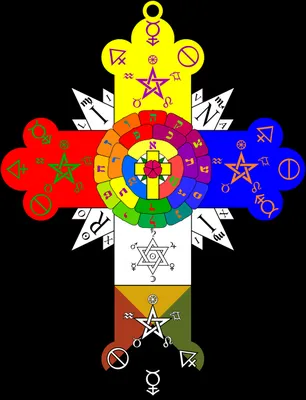
The Hermetic Order of the Golden Dawn, active in Great Britain from the late 19th to early 20th centuries, was a significant magical order within the Western esoteric tradition. Heavily influenced by Rosicrucianism and Freemasonry, it focused on the study and practice of occult Hermeticism and metaphysics. The Order's teachings encompassed esoteric philosophy, the Hermetic Qabalah, astrology, tarot, geomancy, and alchemy in its First Order, while its Second Order, the Rosae Rubeae et Aureae Crucis, delved into magic, scrying, astral travel, and alchemy. Many contemporary magical traditions, including Wicca and Thelema, trace their roots and concepts to the Golden Dawn's influence.
The Order was founded by William Robert Woodman, William Wynn Westcott, and Samuel Liddell Mathers, who were Freemasons and members of the Societas Rosicruciana in Anglia. The foundational Cipher Manuscripts, decoded by Westcott, outlined the Order's grade rituals and curriculum. Unlike some contemporary societies, the Golden Dawn admitted women on equal footing with men. The structure included a First Order for philosophical study and a Second Order for magical practice, with a purported Third Order of Secret Chiefs directing activities from a higher plane.
Origins and Structure
The Hermetic Order of the Golden Dawn emerged in the late 19th century, drawing heavily from Rosicrucianism and Freemasonry. Its founders, William Robert Woodman, William Wynn Westcott, and Samuel Liddell Mathers, were all Freemasons and members of the Societas Rosicruciana in Anglia. Westcott is often seen as the primary instigator. The Order's system was structured hierarchically, similar to Masonic lodges, but notably admitted women as equals to men. The Golden Dawn comprised three distinct Orders. The First Order focused on esoteric philosophy, Hermetic Qabalah, personal development through elemental awareness, and foundational occult arts like astrology, tarot, and geomancy. The Second Order, known as the Rosae Rubeae et Aureae Crucis, concentrated on magical practices, including scrying, astral projection, and alchemy. A Third Order, the Secret Chiefs, was believed to guide the lower orders through spiritual communication.
The Cipher Manuscripts and Founding
The core teachings of the original Golden Dawn were derived from the Cipher Manuscripts, documents written in an encoded English. These manuscripts provided the framework for the Order's grade rituals and a curriculum covering Hermetic Qabalah, astrology, tarot, geomancy, and alchemy. Initially held by Masonic scholar Kenneth R. H. Mackenzie, the manuscripts passed to Rev. A. F. A. Woodford, who then gave them to William Wynn Westcott. Westcott, with assistance from Samuel Liddell Mathers and William Robert Woodman, successfully decoded the manuscripts by 1887. Mathers and Westcott are credited with transforming these outlines into a functional system, with Mathers particularly shaping the Second Order's curriculum and rituals.
Establishment and Expansion
The first temple, Isis-Urania, was established in London in 1888, following Westcott's claimed correspondence with a German Rosicrucian named Anna Sprengel, who allegedly granted permission for the Order's founding and conferred honorary grades upon the founders. The Isis-Urania temple welcomed women on an equal basis with men, distinguishing itself from some other contemporary societies. Initially, the Order functioned as a cohesive First Order, emphasizing philosophical and metaphysical study. By 1892, a Second Order, the Ordo Rosae Rubeae et Aureae Crucis, was formally established for adepts who had completed the First Order's curriculum. This expansion led to the founding of further temples in Great Britain, such as Osiris in Weston-super-Mare and Horus in Bradford in 1888, and Amen-Ra in Edinburgh in 1893. Mathers later founded the Ahathoor temple in Paris in 1893.
Internal Strife and Splintering
By the mid-1890s, the Golden Dawn had gained prominence, attracting over one hundred members from various societal strata, including notable figures like actress Florence Farr, poet W. B. Yeats, and occultist Aleister Crowley. However, internal tensions grew, particularly concerning Mathers's leadership and his association with Crowley. Westcott withdrew from the Order around 1896 or 1897, leaving Mathers in charge. Florence Farr was appointed Chief Adept in Anglia. Dissatisfaction culminated towards the end of 1899, with members of the Isis-Urania and Amen-Ra temples seeking direct contact with the Secret Chiefs. Disputes intensified, leading to a revolt against Mathers's authority. This schism resulted in the formation of new groups, including the Stella Matutina, led by figures like Dr. Robert Felkin, while others, like A. E. Waite, retained the original Isis-Urania name.
Key Ideas
- Esoteric philosophy based on Hermetic Qabalah
- Personal development through study and awareness of classical elements
- Divination practices including tarot and geomancy
- Magical practices such as scrying and astral travel
- The concept of Secret Chiefs guiding esoteric orders
Books by Florence Farr Darcy Kuntz
0 free public domain books · Read online or download
