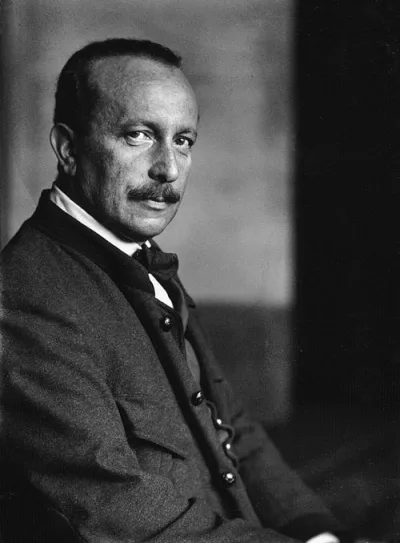
Felix Salten
Felix Salten, author of Bambi, was a prolific Austrian writer and critic who also advocated for Zionism.
Felix Salten, born Siegmund Salzmann in 1869, was an Austrian author and literary critic. Initially changing his name to minimize his Jewish identity and considering conversion due to antisemitism, he later became a vocal supporter of Zionism, inspired by Theodor Herzl. Salten began his career in journalism, working as an art and theater critic for Viennese newspapers and initiating a literary cabaret. He published prolifically throughout his life, producing novels, plays, short stories, travelogues, and essay collections, averaging a book a year.
His most internationally recognized work is "Bambi, a Life in the Woods" (1923), which gained significant fame through Walt Disney's 1942 animated adaptation. While the film brought Salten widespread recognition, it also overshadowed the original novel, rendering both it and the author relatively obscure. Due to rising antisemitism and the banning of his books in Germany, Salten relocated to Switzerland in 1938, where he remained until his death in 1945. He is also considered the likely author of the anonymous erotic novel "Josephine Mutzenbacher."
Literary Career and "Bambi"
Felix Salten, initially known as Siegmund Salzmann, was a prominent figure in Vienna's literary scene, associated with the "Young Vienna" movement. He established himself as a critic for major newspapers and published his first short story collection in 1900. His prolific output included numerous books across various genres, such as plays, novels, travel writings, and essays. Salten also ventured into screenwriting and operetta librettos. His presidency of the Austrian P.E.N. club in 1927 highlights his standing in the literary community. His most famous work, "Bambi: Eine Lebensgeschichte aus dem Walde" (1923), achieved international acclaim, particularly after its adaptation into the iconic Walt Disney animated film in 1942. While the film's immense popularity brought Salten global fame, it concurrently led to the original novel becoming less known.
Zionist Advocacy and Personal Life
Despite early attempts to distance himself from his Jewish heritage due to antisemitism, Felix Salten became a committed advocate for the Zionist movement. Influenced by Theodor Herzl, he contributed anonymously to Herzl's newspaper "Die Welt" and delivered speeches at Zionist events. Salten married actress Ottilie Metzl in 1902, with whom he had two children. His personal life also included a passion for hunting. Beyond "Bambi," Salten wrote a sequel, "Bambi's Children," and his works "Perri" and "The Hound of Florence" also inspired subsequent Disney films. His final years were spent in Zürich, Switzerland, following his departure from Austria due to the escalating persecution of Jews.
Authorship and Legacy
Felix Salten's literary contributions extend beyond his well-known works. He is widely believed to be the author of the anonymously published 1906 novel "Josephine Mutzenbacher: The Life Story of a Viennese Whore, as Told by Herself," a work noted for its social commentary. The immense success and cultural impact of the Disney film "Bambi" significantly eclipsed the original novel, leading to Salten's work becoming somewhat obscure despite his earlier prolific career. His books were banned in Germany by the Nazi regime in 1936, underscoring the political climate of the era. Salten died in 1945 in Switzerland, leaving behind a diverse literary legacy.
Key Ideas
- Zionism and Jewish identity
- Social criticism through literature
- The impact of adaptation on original works
Books by Felix Salten
0 free public domain books · Read online or download
