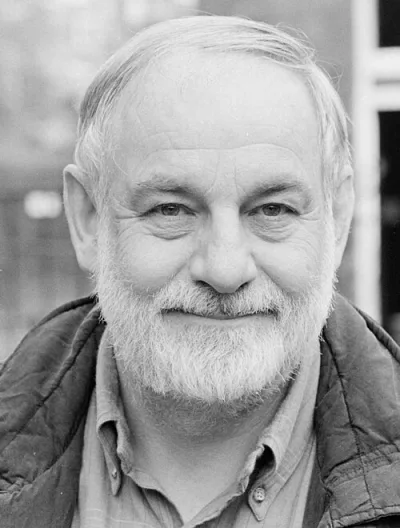
Eric Carle
Eric Carle was a celebrated author and illustrator known for The Very Hungry Caterpillar, whose art blended nature themes with a philosophy of easing childhood transitions.
Eric Carle, born in 1929 in New York and later raised in Germany, was a prolific author and illustrator of children's books. His career took off after collaborating on "Brown Bear, Brown Bear, What Do You See?" and he went on to illustrate over 70 books, many of which he also authored. His most famous work, "The Very Hungry Caterpillar," published in 1969, has achieved global recognition with millions of copies sold and translations into numerous languages.
Carle's artistic style involved creating vibrant, colorful images through collage, using hand-painted papers. His books often incorporated unique features like die-cut pages or interactive elements. He stated his intention was to bridge the gap between home and school for children, aiming to alleviate the fear of the unknown and foster a positive view of learning, which he considered a natural and enjoyable process. He co-founded The Eric Carle Museum of Picture Book Art, dedicated to the art of children's books.
Artistic Philosophy and Themes
Eric Carle's artistic approach was rooted in collage, utilizing hand-painted papers that he meticulously cut and arranged to create his signature bright and engaging illustrations. Many of his books featured innovative elements, such as die-cut pages or even sound effects, adding a tactile and sensory dimension for young readers. The inspiration for his narratives frequently stemmed from nature, often drawn from childhood experiences of walking through meadows and woods with his father. Carle articulated a pedagogical intent behind his work, aiming to serve as a bridge between the security of home and the unfamiliarity of school. He viewed the transition to school as a significant childhood challenge, second only to birth, and sought through his books to replace potential fear with a message of warmth, security, and the inherent joy and fascination of learning, believing children possess natural creativity and eagerness.
Life and Career Trajectory
Born in Syracuse, New York, Eric Carle returned to Germany with his family at age six and received his art education at the State Academy of Fine Arts Stuttgart. His formative years were marked by the disruptions of World War II, including his father's imprisonment and his own conscription to dig trenches on the Siegfried Line at fifteen, experiences that he later suggested may have contributed to post-traumatic stress. After the war, Carle returned to the United States, settling in New York City in 1952. He initially worked as a graphic designer for The New York Times and later became an advertising agency art director. His entry into children's literature was facilitated by educator Bill Martin Jr., who was impressed by Carle's illustration for an advertisement. This collaboration led to the successful book "Brown Bear, Brown Bear, What Do You See?", which launched Carle's career as a celebrated illustrator and author.
Key Ideas
- Bridging the gap between home and school for children.
- Counteracting childhood fear of the unknown with positive messages.
- Promoting learning as a fascinating and fun process.
- Using nature as inspiration for children's stories.
- Artistic technique of collage with hand-painted papers.
Notable Quotes
“You know about the Siegfried line? To dig trenches. Fifteen. And the first day three people were killed a few feet away. Not children — Russian prisoners or something. The nurses came and started crying. And in Stuttgart, our home town, our house was the only one standing. When I say standing, I mean the roof and windows are gone, and the doors. And ... well, there you are.”
“With many of my books I attempt to bridge the gap between the home and school. To me home represents, or should represent; warmth, security, toys, holding hands, being held. School is a strange and new place for a child. Will it be a happy place? There are new people, a teacher, classmates—will they be friendly?”
“I believe the passage from home to school is the second biggest trauma of childhood; the first is, of course, being born. Indeed, in both cases, we leave a place of warmth and protection for one that is unknown. The unknown often brings fear with it. In my books, I try to counteract this fear, to replace it with a positive message. I believe that children are naturally creative and eager to learn. I want to show them that learning is really both fascinating and fun.”
Books by Eric Carle
0 free public domain books · Read online or download
