Elmo Jean La Seer
This text details Japanese verb conjugation, focusing on negative forms and their historical development and variations.
The provided text delves into the complex system of Japanese verb conjugation, specifically examining how verbs are modified to express negation and other grammatical functions. It highlights that Japanese conjugation alters word endings while preserving the stem, and that these changes are independent of person, number, or gender. The article traces the evolution of negative suffixes, contrasting the standard '-nai' with older forms like '-n' and '-nu', and discusses their origins and regional variations. It also touches upon the agglutinating nature of Japanese verbs, where multiple suffixes can be attached to express intricate meanings. Special attention is given to the nuances of expressing negation, including its use in rhetorical questions and its relationship with affirmation. The text further explores the specific case of the verb 'shiru' (to know), analyzing the semantic differences between its negative forms 'shiranai' and 'shitte inai', and how they relate to the concept of active recognition versus perpetuated ignorance.
The Mechanics of Japanese Verb Conjugation
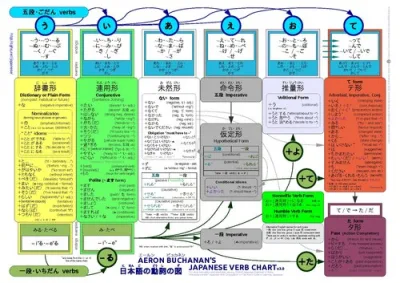
Japanese verbs undergo morphological changes, primarily at their endings, to alter meaning or grammatical function, while the word stem remains consistent. This system is independent of factors like person, number, or gender of the subject. The conjugated forms can convey a wide array of meanings, including negation, tense (present and past), volition, passive voice, causation, imperative and conditional moods, and ability. Furthermore, Japanese verbs exhibit agglutinating properties, allowing multiple suffixes to be appended to a single verb form, creating complex expressions of combined meanings. Traditionally, conjugable words are understood to have six distinct bases or stems, which serve as the foundation for these modifications.
The Evolution and Nuances of Negation
The expression of negation in Japanese has a rich history, with various suffixes evolving over time. The standard negative form typically uses the '-nai' suffix, which originated from eastern dialects and is believed to be derived from the adjective 'nai' (to not exist). This form largely displaced the older western and classical '-n' and '-nu' suffixes. The text notes the specific case of the verb 'aru', where the regular negative 'aranai' is rarely used, with exceptions found in specific literary contexts. The '-n' suffix, a shortened form of '-nu', is still present in modern Japanese, particularly in certain dialects and literary uses, and its infinitive form '-zu' persists in writing. The polite '-masen' form, the current negative of '-masu', is suggested to have western origins, contrasting with the easternized '-mashinai'.
Semantic Distinctions in 'Knowing' and 'Not Knowing'
The verb 'shiru' (to know) presents a unique case in Japanese negation. While 'shiranai' is the morphological negative of 'shiru', it semantically functions as the negative of both 'shiru' (to learn/find out) and 'shitte iru' (to know/be in a state of knowing). The construction 'shitte inai' implies a continued state of ignorance or a failure to acquire knowledge. The text highlights that 'shiranai' is often preferred even when 'shitte iru' is used, a phenomenon not common with other verbs. This distinction is explored through examples illustrating the perpetuation of ignorance versus the simple lack of knowledge, and its usage in specific grammatical contexts, such as with perfect aspects.
Books by Elmo Jean La Seer
2 free public domain books · Read online or download