Eliphas Lévi
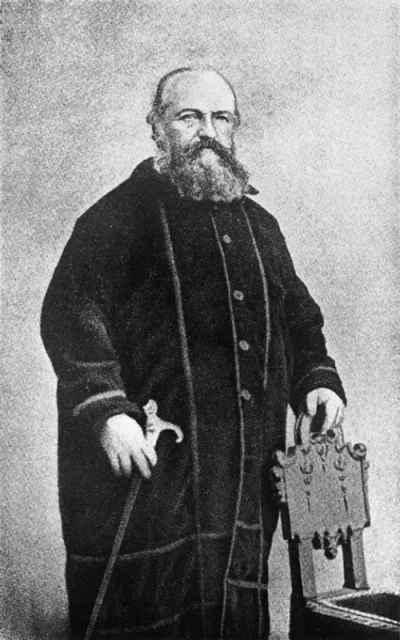
Eliphas Lévi was a French occultist, writer, and ceremonial magician who significantly influenced modern Western esotericism.
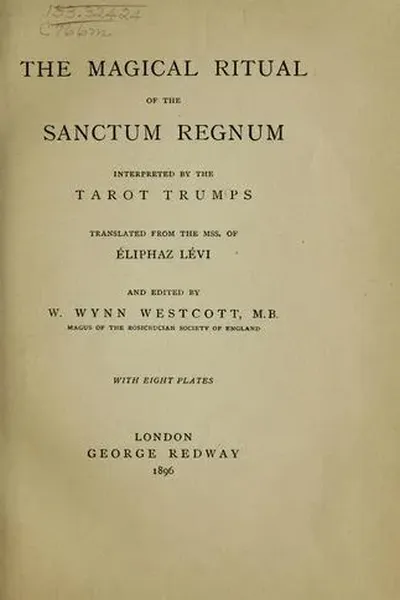
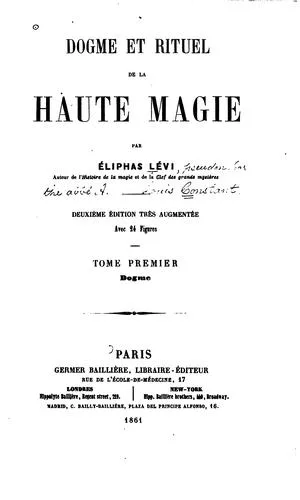
Eliphas Lévi, born Alphonse Louis Constant, was a French writer and esotericist known for his extensive works on magic, Kabbalah, and occultism. Initially on a path toward the Catholic priesthood, he left the seminary in his mid-twenties, later becoming a ceremonial magician and a prolific author. He adopted the pen name Eliphas Lévi, a Hebrew adaptation of his given names. Lévi's writings gained attention among esotericists and artists in Paris and London. He developed a unique system of magic, incorporating elements like the Tarot, and his ideas profoundly impacted later occult movements such as the Hermetic Order of the Golden Dawn and Theosophy. He also posited distinctions for the symbolism of the pentagram.
Lévi's early life involved a period of spiritual searching and financial hardship. After leaving the seminary, he faced poverty and pursued various intellectual and spiritual paths, including an unsuccessful stint in a monastery and a period of imprisonment for a political publication. Around the age of 40, he experienced a significant spiritual and financial crisis that led him more deeply into the study and practice of occultism. His later life saw him engage with political events and develop his theories on magic, often contrasting his views with contemporary Spiritualism. Despite the obscurity of some of his teachings, Lévi presented himself as a scholar offering knowledge for humanity's benefit, without claiming membership in secret societies.
Early Life and Spiritual Path
Born Alphonse Louis Constant in Paris, Lévi's early life was marked by a pursuit of religious and intellectual understanding. He entered the seminary of Saint Sulpice with the intention of becoming a Catholic priest, even being ordained as a deacon. However, he left the seminary shortly before his final ordination, a decision that caused him considerable personal difficulty and estranged him from his superiors. While the exact reasons remain debated, possibilities include developing unconventional doctrinal views or experiencing personal doubts. He continued to wear clerical attire for several years after leaving. During this period, he experienced poverty and worked as a tutor, encountering influential figures like Simon Ganneau and Flora Tristan. He briefly entered monastic life but found he could not adhere to its discipline. His early writings, such as 'La Bible de la liberté,' led to his imprisonment.
Transition to Occultism and Magical Theory
Around the age of 40, Lévi underwent a profound spiritual and financial crisis, which propelled him further into the study of esotericism and the occult. This period marked a significant shift in his life and intellectual pursuits. He became a ceremonial magician and began publishing extensively on topics including magic, Kabbalah, alchemy, and occult philosophy. Lévi's magical system was characterized by its intellectual rigor and synthesis of various esoteric traditions. He famously incorporated Tarot cards into his magical practices, making them a central element for subsequent Western magicians. He also distinguished between different orientations of the pentagram, assigning symbolic meanings to each, with one point up representing good and one point down representing evil.
Influence and Legacy
Eliphas Lévi's works achieved considerable renown, particularly after his death, partly due to the burgeoning popularity of Spiritualism, though Lévi himself diverged from its tenets. He critiqued Spiritualism's concept of autonomous spirits, suggesting instead that only mental images and 'astral forces' persisted, which skilled magicians could manipulate. He believed phenomena like table-turning were manifestations of nascent magnetic currents. Lévi's teachings, though sometimes obscure, were presented without fanaticism, and he offered his knowledge freely, not claiming to be part of a secret society. His profound impact is evident in his influence on major occult organizations like the Hermetic Order of the Golden Dawn, as well as figures such as Aleister Crowley and Helena Blavatsky, solidifying his position as a pivotal figure in modern Western esotericism.
Key Ideas
- Magic as a science and a path to spiritual understanding
- Integration of Kabbalah, alchemy, and Tarot into magical practice
- Symbolic interpretation of religious and occult imagery
- Distinction in pentagram symbolism (one point up vs. one point down)
- Belief in astral forces and magnetic currents influencing phenomena
Notable Quotes
“I ceased being a freemason, at once, because the Freemasons, excommunicated by the Pope, did not believe in tolerating Catholicism ... [and] the essence of Freemasonry is the tolerance of all beliefs.”
“The phenomena which quite recently have perturbed America and Europe, those of table-turning and fluidic manifestations, are simply magnetic currents at the beginning of their formation, appeals on the part of Nature inviting us, for the good of humanity, to reconstitute great sympathetic and religious chains.”
“A poor and obscure scholar [who] has found the lever of Archimedes, and he offers it to you for the good of humanity alone, asking nothing whatsoever in exchange.”
Books by Eliphas Lévi
0 free public domain books · Read online or download