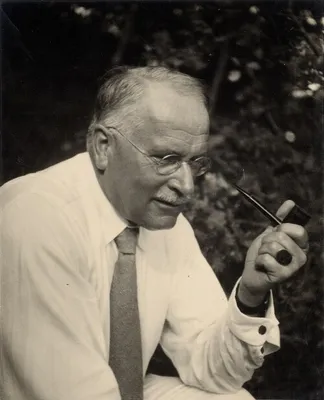
Edward C Whitmont
Carl Jung was a Swiss psychiatrist who founded analytical psychology, exploring archetypes, the collective unconscious, and individuation.
Carl Gustav Jung, born in Switzerland in 1875, was a psychiatrist and psychologist who established the field of analytical psychology. Initially working with and corresponding with Sigmund Freud, Jung diverged from psychoanalysis due to differing visions, developing his own comprehensive system. He is widely recognized as a highly influential figure in psychology and beyond, with his work impacting fields such as anthropology, literature, and religious studies.
Jung's theories introduced concepts like archetypes, the collective unconscious, synchronicity, and the process of individuation, which he considered the primary developmental task for humans. His insights, partly inspired by early personal experiences and later research, explored the depths of the human psyche. Jung was also a prolific writer, artist, and craftsman, with many of his works published posthumously.
Early Life and Influences
Born in Kesswil, Switzerland, Carl Gustav Jung's early life was marked by his parents' contrasting personalities and family history. His father, Paul Achilles Jung, was a pastor whom Carl perceived as weak, while his mother, Emilie Preiswerk, was seen as unreliable and eccentric, experiencing periods of depression and claiming to see spirits. Jung's maternal grandfather, Samuel Preiswerk, was a clergyman, Hebraist, author, and editor with an interest in the occult and an early advocate for Zionism. This complex family background, including a father who was the grandson of a noted physician and university rector, influenced Jung's developing views on the psyche and spirituality. His childhood experiences, including a perceived spiritual vision and periods of illness, contributed to his later theories.
Development of Analytical Psychology
Jung initially pursued medicine, drawn to its blend of biological and spiritual aspects, after considering ministry and archaeology. His early career involved research at the Burghölzli psychiatric hospital and a significant relationship with Sigmund Freud. Jung was seen by Freud as a potential successor and a means to legitimize psychoanalysis, particularly given Freud's Jewish background amidst rising antisemitism. Jung was appointed president of the International Psychoanalytical Association. However, Jung's independent research and unique perspective eventually led to a painful separation from Freud and the establishment of his own school of thought, analytical psychology, distinct from psychoanalysis.
Key Concepts and Later Life
Central to Jung's analytical psychology is the concept of individuation, a lifelong process of integrating conscious and unconscious elements to form a differentiated self. He also developed influential ideas such as archetypes, the collective unconscious, psychological complexes, synchronicity, and the distinctions between introversion and extraversion. Jung's belief that alcoholics could recover through a 'vital spiritual or religious experience' played a role in the founding of Alcoholics Anonymous. A prolific writer, many of Jung's works were published after his death, continuing to influence diverse fields.
Key Ideas
- Individuation: The process of psychological differentiation and integration of the self.
- Archetypes: Universal, archaic patterns and images that derive from the collective unconscious.
- Collective Unconscious: A part of the unconscious mind derived from ancestral memory and experience.
- Synchronicity: Meaningful coincidences that seem to have no causal relationship.
- Psychological Complexes: A core pattern of emotions, memories, perceptions, and wishes in the personal unconscious.
- Extraversion and Introversion: Concepts describing the outward or inward focus of psychic energy.
Books by Edward C Whitmont
0 free public domain books · Read online or download
