Dayanand
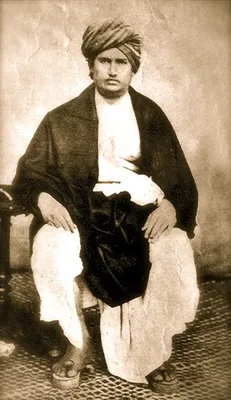
Dayanand Saraswati was a Hindu philosopher and social reformer who founded the Arya Samaj, advocating Vedic principles and opposing idolatry.
Dayanand Saraswati, born Mool Shankar Tiwari, was a significant Hindu philosopher and social reformer in 19th-century India. He founded the Arya Samaj, a movement dedicated to reforming Hinduism by returning to Vedic principles. Saraswati was a vocal critic of idolatry and elaborate rituals, promoting a return to what he considered the pure, original Vedic religion. His influential book, 'Satyarth Prakash,' explored Vedic philosophy and human duties. He is also credited with being the first to call for 'India for Indians' in 1876, a slogan later adopted by other nationalist leaders. Revered by many, including prominent figures like Sarvepalli Radhakrishnan and Sri Aurobindo, Saraswati is recognized as one of the 'makers of Modern India.'
His philosophical framework was deeply rooted in the infallible authority of the Vedas, which he believed to be the sole uncorrupted source of divine knowledge. He also accepted the core teachings of the Principal Upanishads and certain Vedanga and Darshana Shastras, provided they aligned with Vedic principles. Saraswati rejected many later Puranic texts and Tantric traditions, viewing them as deviations that introduced idol worship and contradictory practices. He emphasized the eternal nature of the Supreme Lord, individual souls (Jivatmas), and Nature (Prakriti), outlining a cyclical view of creation, dissolution, and rebirth governed by karma, with the ultimate goal of liberation (Moksha).
Founding the Arya Samaj and Vedic Revival
Dayanand Saraswati established the Arya Samaj as a reform movement aimed at revitalizing Hinduism by returning to its ancient Vedic roots. He strongly denounced the prevalent practices of idolatry and ritualistic worship, advocating instead for the revival of what he perceived as the pure Vedic religion. His extensive commentaries on the Vedas, written in Sanskrit and Hindi, sought to clarify their teachings and their relevance to human life and duties. This emphasis on the Vedas as the ultimate authority, free from later interpolations and misinterpretations, formed the cornerstone of his reformist agenda. He believed the Vedas promoted scientific inquiry and the discovery of ultimate truth.
Philosophical Underpinnings and Authority of the Vedas
Saraswati's philosophy centered on the absolute and infallible authority of the four Vedas: Rigveda, Yajurveda, Samaveda, and Atharvaveda. He considered these ancient texts as divinely revealed and perfectly preserved, serving as the only true and uncorrupted sources of Dharma. While accepting certain Upanishads and classical philosophical texts (Darshana Shastras) and grammatical works (Vedangas), he maintained that their validity was contingent upon their alignment with Vedic teachings. He rejected many later texts, including the Puranas and Tantric scriptures, deeming them contradictory to Vedic principles and responsible for introducing practices like idol worship.
Cosmology and the Nature of Reality
Dayanand's cosmology posits three eternal entities: the Supreme Lord (Paramatma), the individual souls (Jivatmas), and Nature (Prakriti). Nature, the material cause of the universe, exists in a state of equilibrium until disturbed by the Supreme Lord to initiate creation. This process involves cycles of creation and dissolution, governed by a cosmic timeline. Souls are distinct, eternal, and capable of achieving liberation (Moksha) through self-realization, understanding Nature, and the Supreme Lord. Their journey involves repeated births and deaths, influenced by karma, with the potential to ascend or descend in the cycle of existence until ultimate liberation is attained.
Social Reforms and Legacy
Beyond his theological and philosophical contributions, Dayanand Saraswati was a prominent social reformer. He actively opposed the practice of untouchability and championed the cause of equal rights for women, advocating for their education and participation in societal life. His call for 'Swaraj' or 'India for Indians' in 1876 resonated with nationalist sentiments and was later adopted by prominent leaders. Many influential figures across various fields, including politics and social reform, were inspired by his teachings and legacy, solidifying his position as a key figure in the making of modern India.
Key Ideas
- Infallible authority of the Vedas
- Rejection of idolatry and ritualism
- Advocacy for Vedic religion revival
- Concept of eternal entities: God, Souls, Nature
- Cyclical view of creation and dissolution
- Karma and reincarnation
- Goal of Moksha (Liberation)
- Social reform: opposition to untouchability, women's rights
- Call for Swaraj ('India for Indians')
Books by Dayanand
3 free public domain books · Read online or download