David Pond
Walden Pond, immortalized by Thoreau, is a historically significant natural site with deep philosophical and potentially esoteric connections.
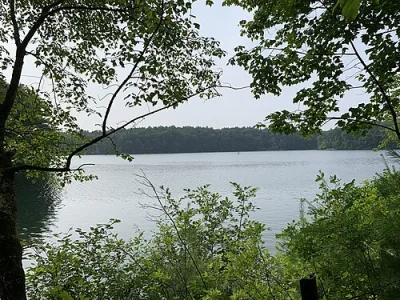
Walden Pond, situated in Concord, Massachusetts, is a kettle hole formed by retreating glaciers. It gained prominence through Henry David Thoreau's seminal work, "Walden; or, Life in the Woods," where he chronicled his two-year stay in a cabin on its shores starting in 1845. The pond and its surrounding land are now preserved as Walden Pond State Reservation, recognized as a National Historic Landmark for its association with Thoreau. The area's history is complex, having been a site of mining, dumping, and past habitation, which Thoreau's writings, according to some interpretations, aimed to reclaim and imbue with respect for nature.
Beyond its natural and historical significance, Thoreau's writings on Walden Pond explore its physical properties and deeper, incorporeal experiences. He contemplated the pond's pristine water, its mirror-like surface, and its geological formation, while also referencing local legends and potential mystical associations. Some interpretations suggest Thoreau's descriptions echo themes found in Romantic literature, hinting at the pond as a locale for profound, perhaps even Grail-like, experiences. The preservation of Walden Pond has involved significant efforts, including legal battles to prevent development and the establishment of projects to protect the surrounding woodlands.
Philosophical and Mystical Interpretations
Henry David Thoreau's time at Walden Pond deeply influenced his philosophical outlook, particularly his transcendentalist beliefs. In "The Ponds" section of his book "Walden," he meticulously details the pond's physical attributes, from its water quality and temperature to its geological makeup and reflective surface. However, his contemplation extended beyond the material, exploring incorporeal experiences associated with the water. Thoreau referenced local folklore, including an Indian legend about a sunken hill and a potentially mythical iron chest at the pond's bottom, which he juxtaposed with his own observations of geological evidence. Some scholars interpret these narratives within the framework of Romanticism, suggesting Thoreau may have been alluding to the pond as a site for profound, almost mystical encounters, drawing parallels to legends like the Grail Quest.
Historical Context and Preservation
Walden Pond's history is marked by its transformation from a neglected, exploited area to a protected landmark. Before Thoreau's residency, the land was used for mining and dumping, and had been a place where enslaved people lived. Thoreau's friend and mentor, Ralph Waldo Emerson, owned the land where Thoreau built his cabin. Thoreau's writings brought national attention to the pond, advocating for a renewed respect for nature and the reclamation of abused landscapes. The area faced threats of development in the 20th century, leading to legal actions that ultimately preserved the site. Significant efforts, including the establishment of the Walden Woods Project, have continued to protect the surrounding environment, ensuring its preservation for future generations.
Key Ideas
- Transcendentalism and nature
- The philosophical significance of natural landscapes
- Reclamation and respect for exploited land
- Potential for mystical or legendary interpretations of natural sites
Notable Quotes
“The sweltering inhabitants of Charleston and New Orleans, of Madras and Bombay and Calcutta, drink at my well ... The pure Walden water is mingled with the sacred water of the Ganges”
“Some have been puzzled to tell how the shore became so regularly paved. My townsmen have all heard the tradition -- the oldest people tell me that they heard it in their youth -- that anciently the Indians were holding a pow-wow upon a hill here, which rose as high into the heavens as the pond now sinks deep into the earth, and they used much profanity, as the story goes, though this vice is one of which the Indians were never guilty, and while they were thus engaged the hill shook and suddenly sank, and only one old squaw, named Walden, escaped, and from her the pond was named. It has been conjectured that when the hill shook these stones rolled down its side and became the present shore. It is very certain, at any rate, that once there was no pond here, and now there is one; and this Indian fable does not in any respect conflict with the account of that ancient settler whom I have mentioned, who remembers so well when he first came here with his divining-rod, saw a thin vapor rising from the sward, and the hazel pointed steadily downward, and he concluded to dig a well here. As for the stones, many still think that they are hardly to be accounted for by the action of the waves on these hills; but I observe that the surrounding hills are remarkably full of the same kind of stones, so that they have been obliged to pile them up in walls on both sides of the railroad cut nearest the pond; and, moreover, there are most stones where the shore is most abrupt; so that, unfortunately, it is no longer a mystery to me. I detect the paver. If the name was not derived from that of some English locality -- Saffron Walden, for instance -- one might suppose that it was called originally Walled-in Pond.”
“An old man who used to frequent this pond nearly sixty years ago, when it was dark with surrounding forests, tells me that in those days he sometimes saw it all alive with ducks and other water-fowl, and that there were many eagles about it. He came here a-fishing, and used an old log canoe which he found on the shore. It was made of two white pine logs dug out and pinned together, and was cut off square at the ends. It was very clumsy, but lasted a great many years before it became water-logged and perhaps sank to the bottom. He did not know whose it was; it belonged to the pond. He used to make a cable for his anchor of strips of hickory bark tied together. An old man, a potter, who lived by the pond before the Revolution, told him once that there was an iron chest at the bottom, and that he had seen it. Sometimes it would come floating up to the shore; but when you went toward it, it would go back into the deep water and disappear ...”
Books by David Pond
6 free public domain books · Read online or download