David Myriad
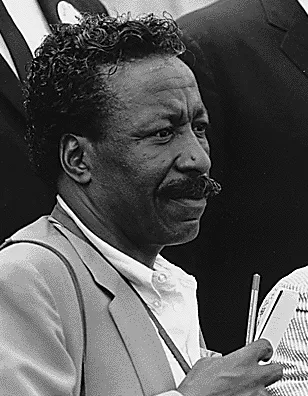
Gordon Parks was a pioneering Black American photographer, filmmaker, and author known for his powerful social commentary and iconic imagery.
Gordon Parks (1912-2006) was a multifaceted American artist who achieved prominence as a photographer, composer, author, poet, and filmmaker. He became a significant figure in documentary photojournalism from the 1940s to the 1970s, focusing on critical issues such as civil rights, poverty, and the African American experience. Parks also excelled in glamour photography and is widely recognized for his impactful images of impoverished Americans, his extensive work for Life magazine, and his directorial contributions to films like 'Shaft' and 'The Learning Tree.'
Parks was among the first Black filmmakers to direct within the Hollywood system, contributing to the blaxploitation genre with films that explored the experiences of enslaved people and struggling Black Americans. His film 'The Learning Tree' is noted as the first feature by a Black director financed by a major Hollywood studio. His early life was marked by hardship, including attending segregated schools and facing racial discrimination, which profoundly influenced his artistic perspective and his commitment to social justice through his work.
Early Life and Influences
Born in Fort Scott, Kansas, Gordon Parks was the youngest of fifteen children. His upbringing in a segregated environment, including attending a school where Black students faced limitations on social and academic pursuits, deeply shaped his worldview. A teacher's discouraging remarks about his aspirations for higher education and a traumatic childhood incident involving racial prejudice left lasting impressions. Following his mother's death and a difficult period living with his sister, Parks was forced to become self-reliant at a young age. He navigated various jobs, from working in brothels to playing music and sports, eventually finding himself in Chicago after the 1929 stock market crash. A brief period working in an elite club offered him access to books and observations of societal structures, influencing his later artistic endeavors.
Photographic Career and Social Commentary
Parks's journey into photography began at age twenty-eight when he purchased his first camera. He was largely self-taught, and his early work quickly gained recognition, leading to opportunities in fashion and portraiture. A significant turning point was his 1942 Julius Rosenwald Fellowship, which allowed him to join the Farm Security Administration (FSA). There, under Roy Stryker, he produced seminal works like 'American Gothic, Washington, D.C.,' a powerful image of Ella Watson that critiqued American society and racism. This photograph, though controversial, cemented his reputation as a photographer using his camera as a tool for social change. After the FSA, Parks continued his work with the Office of War Information and later with Standard Oil, documenting diverse aspects of American life.
Filmmaking and Cultural Impact
Transitioning into filmmaking, Parks directed documentaries focused on Black life in urban ghettos for National Educational Television. His 1969 film adaptation of his novel, 'The Learning Tree,' marked a significant achievement as the first feature film by a Black director funded by a major Hollywood studio. He wrote the screenplay and composed the score for the film, which was shot in his hometown. Parks's directorial work extended to the highly successful 1971 film 'Shaft,' a detective story that became a cultural phenomenon and helped define the blaxploitation genre. His cinematic contributions further amplified his voice in addressing Black experiences and societal issues.
Key Ideas
- Using photography as a tool for social commentary and change
- Documenting the African American experience, civil rights, and poverty
- Bridging artistic disciplines: photography, film, writing, and music
- Challenging racial segregation and discrimination through art
Books by David Myriad
1 free public domain book · Read online or download