David Javane
Gil Blas is a picaresque novel by Alain-René Lesage, detailing a protagonist's rise through various societal levels, widely influential in literature.
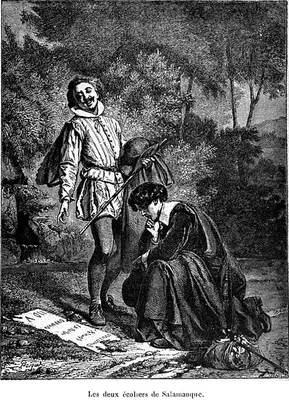
Alain-René Lesage's "L'Histoire de Gil Blas de Santillane," published between 1715 and 1735, is a picaresque novel chronicling the life of Gil Blas. Born into humble circumstances, Gil Blas embarks on a journey that leads him through a spectrum of society, from university student and robber's accomplice to a valet and eventually a court favorite. His adaptability and wit allow him to navigate diverse social strata, observing both secular and clerical life, and encountering a range of characters from the disreputable to the powerful.
The novel gained significant popularity and was translated into English, notably by Tobias Smollett. Its literary significance lies in Lesage's use of witty characters and social commentary, presenting archetypes of various professions and social classes. "Gil Blas" has been referenced and alluded to in numerous literary works by authors such as Jean-Jacques Rousseau, Jonathan Swift, Edward Moore, Vasily Narezhny, James Morier, Honoré de Balzac, Mark Twain, and Edgar Allan Poe, among many others, highlighting its enduring impact on narrative tradition and character development.
Social Observation and Character Archetypes
Lesage's "Gil Blas" is notable for its detailed portrayal of societal layers and its use of archetypal characters. Through the eyes of the adaptable Gil Blas, the novel presents a panorama of 18th-century life, encompassing individuals from various walks of life, including clergy, nobility, and commoners. The narrative employs witty valets, deceitful masters, and figures representing different professions, such as doctors and scholars, often with a satirical edge. This approach allowed Lesage to critique societal norms and human foibles by presenting each class and occupation as a recognizable type, contributing to the novel's enduring relevance and its influence on subsequent literary characterizations.
Literary Influence and Adaptations
The impact of "Gil Blas" on world literature is extensive, evidenced by its frequent mentions and allusions in the works of many prominent authors. From Rousseau's reflection on moral observation to Swift's satirical advice to servants, the novel served as a touchstone for discussing human nature and social dynamics. Its picaresque structure and protagonist's journey through life's vicissitudes became a model for subsequent narratives. Authors like James Morier, with "The Adventures of Hajji Baba of Ispahan," and Vasily Narezhny, with "A Russian Gil Blas," directly imitated or were inspired by Lesage's work. The character's archetype also influenced the development of protagonists in works by Mark Twain, Edgar Allan Poe, and Charles Dickens, solidifying "Gil Blas" as a foundational text in the picaresque tradition.
Key Ideas
- Picaresque narrative structure
- Social satire through character archetypes
- Adaptability and wit as survival tools
- Observation of diverse societal strata
Books by David Javane
1 free public domain book · Read online or download