David Hawthorne
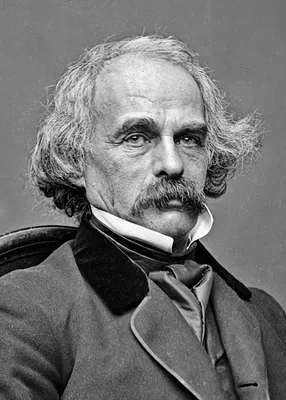
Nathaniel Hawthorne was an American novelist exploring morality, sin, and religion, often with a dark romantic and anti-Puritan lens.
Nathaniel Hawthorne, born in 1804 in Salem, Massachusetts, was an American author known for his novels and short stories that frequently delved into themes of history, morality, and religion. His ancestry included figures involved in the Salem witch trials, a fact that influenced his decision to alter his surname. Hawthorne attended Bowdoin College, where he befriended Franklin Pierce. After graduating, he published his first novel, 'Fanshawe,' which he later disavowed. He worked in various roles, including at the Boston Custom House and briefly at the transcendentalist community Brook Farm, before marrying Sophia Peabody in 1842. Their marriage was long and supportive, with Sophia greatly admiring his work. Hawthorne's literary output, including 'The Scarlet Letter' and 'The Blithedale Romance,' is considered part of the Romantic movement, particularly dark romanticism, often featuring moral metaphors and exploring the darker aspects of human nature.
Ancestral Influence and Early Life
Born Nathaniel Hathorne in Salem, Massachusetts, on July 4, 1804, the author's family had deep roots in the region, including ancestors involved in the Salem witch trials. This lineage, particularly his judge great-great-grandfather John Hathorne, likely prompted him to add a 'w' to his surname, seeking to distance himself from this notorious past. His father, a sea captain, died when Hawthorne was young, leading his mother to move the family in with relatives. Hawthorne's early life included a period of lameness after an injury and a fondly remembered time living near Sebago Lake in Maine. He attended Bowdoin College starting in 1821, where he formed a lasting friendship with future president Franklin Pierce and met Henry Wadsworth Longfellow. Despite his uncle's financial support, Hawthorne described himself as an 'idle student,' more interested in his own thoughts than formal studies.
Literary Beginnings and Thematic Exploration
Hawthorne's literary career began with the anonymous publication of 'Fanshawe' in 1828, a novel based on his college experiences that he later tried to suppress. He contributed numerous short stories to periodicals, which were eventually collected in 'Twice-Told Tales' in 1837, gaining him local recognition. He also edited the 'American Magazine of Useful and Entertaining Knowledge' and held a position at the Boston Custom House. His writing often explored New England history and featured moral allegories with an anti-Puritan sentiment. His fiction is categorized within the Romantic movement, specifically dark romanticism, focusing on themes of inherent human evil and sin, often presenting complex psychological portraits and moral lessons. His work also included a biography for Franklin Pierce's presidential campaign.
Marriage, Family, and Later Years
In 1842, Hawthorne married Sophia Peabody, an illustrator and transcendentalist. He had briefly joined Brook Farm, a transcendentalist community, to save money for their marriage, an experience that later inspired his novel 'The Blithedale Romance.' The couple settled in Concord, Massachusetts, at The Old Manse, where Hawthorne wrote many tales collected in 'Mosses from an Old Manse.' Sophia, who suffered from migraines, found relief after meeting Hawthorne, and they shared a long and devoted marriage. They had three children: Una, Julian, and Rose. Hawthorne held several official appointments, including Surveyor for the District of Salem, which provided financial stability but sometimes interrupted his writing. His later novels, including 'The Scarlet Letter,' achieved significant success, leading to a political appointment as consul that took his family to Europe before their return to Concord in 1860. Hawthorne died in 1864.
Key Ideas
- Exploration of morality and sin
- Anti-Puritan themes
- Dark Romanticism
- Psychological complexity in characters
- Moral metaphors
Notable Quotes
“I was educated (as the phrase is) at Bowdoin College. I was an idle student, negligent of college rules and the Procrustean details of academic life, rather choosing to nurse my own fancies than to dig into Greek roots and be numbered among the learned Thebans.”
“I have not lived, but only dreamed about living.”
“Those were delightful days, for that part of the country was wild then, with only scattered clearings, and nine tenths of it primeval woods.”
“I am always so dazzled and bewildered with the richness, the depth, the ... jewels of beauty in his productions that I am always looking forward to a second reading where I can ponder and muse and fully take in the miraculous wealth of thoughts.”
“A spectacle of such perfect horror ... She was the very image of death-agony.”
Books by David Hawthorne
1 free public domain book · Read online or download