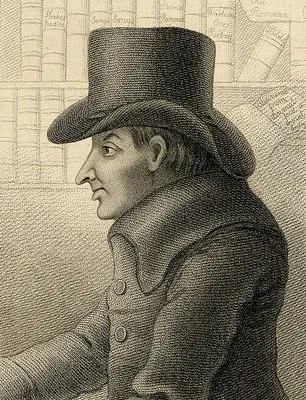
Darren W Ritson
Joseph Ritson was an English antiquary, early vegetarian activist, and collector of folklore, known for his scholarly work and critical writing.
Joseph Ritson (1752–1803) was an English antiquary and writer, born in Stockton-on-Tees and educated for the law, eventually settling in London as a conveyancer. He dedicated his leisure time to literary pursuits, gaining recognition for his critical analyses of contemporary scholarship. Ritson became a vocal supporter of the French Revolution after a visit to France in 1791. He is also acknowledged as an influential figure in the early vegetarian movement, advocating for abstinence from animal food on moral grounds. His work included collections of English songs, ballads, and nursery rhymes, most notably his scholarly edition of Robin Hood ballads.
Ritson's approach to scholarship was marked by meticulous accuracy in textual matters, though his critical writings were often characterized by a sharp, bitter tone that roused considerable opposition. Despite his temperament, he earned respect for his research and dedication to preserving old texts. He also developed eccentricities, such as adopting his own reformed spelling system in later works. Ritson's life ended tragically; he experienced a mental collapse in 1803, barricaded himself in his rooms, destroyed manuscripts, and was committed to an asylum where he died. He was an atheist.
Literary Scholarship and Criticism
Joseph Ritson made a significant impact on literary scholarship through his rigorous editing and critical engagement with existing works. He is credited with producing the first scholarly collection of Robin Hood ballads. Ritson's critical approach, however, was often confrontational. He published sharp critiques of prominent scholars like Thomas Warton, Samuel Johnson, George Steevens, and Bishop Percy, frequently employing acerbic language that generated controversy. Despite the harshness of his criticism, Ritson's own research was characterized by a deep commitment to accuracy in the texts he edited, including old songs, ballads, and metrical romances. His dedication to preserving and presenting these works earned him a reputation for industry and thoroughness among his peers.
Folklore Collections and Philosophy
Beyond his academic criticisms, Ritson was a notable collector and editor of English folklore. His collections included nursery rhymes, such as those found in 'Gammer Gurton's Garland,' which he compiled partly for his nephew, drawing inspiration from existing popular works like 'Mother Goose's Melodies.' Ritson's work in this area reflected a desire to instill sound morality in young readers. His interpretation of Robin Hood, for instance, infused the legend with a political dimension, framing the outlaw's actions as a redistribution of wealth from the rich to the poor, a perspective aligned with his Jacobin sympathies. This philosophical underpinning also extended to his views on social justice, as evidenced by his strong stance on vegetarianism.
Early Vegetarianism and Moral Advocacy
Joseph Ritson was a prominent early activist for vegetarianism, adopting a diet of vegetables and milk in 1772. He articulated his views in 'An Essay on Abstinence from Animal Food, as a Moral Duty,' published in 1802. This work presented arguments for abstaining from animal products based on health and moral principles, positioning him as a pioneer in the animal rights movement. His advocacy was considered influential for subsequent vegetarians, despite facing criticism during his own time. Ritson's dedication to his principles, even in the face of societal norms, highlights a consistent thread of moral conviction running through his intellectual and personal life.
Key Ideas
- Scholarly editing and preservation of English folklore and ballads.
- Advocacy for vegetarianism based on moral and health arguments.
- Critical analysis of literary scholarship, often with a confrontational tone.
- Interpretation of folklore through a lens of social justice and redistribution.
Notable Quotes
“Ritson is the oddest, but most honest of all our antiquarians, and he abuses Percy and Pinkerton with less mercy than justice”
“That same power which authorises kings to take it where it can be worst spared, and give it where it is least wanted.”
Books by Darren W Ritson
0 free public domain books · Read online or download
