Darcy K Ntz
The Golden Dawn was a late 19th-century British secret society that significantly influenced Western occultism through its magical teachings.
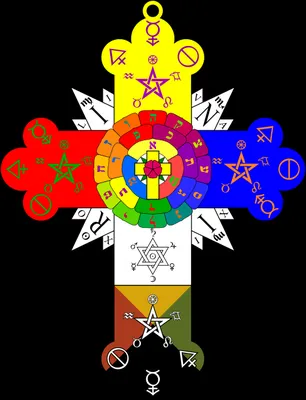
The Hermetic Order of the Golden Dawn, often simply called the Golden Dawn, was a secret society active in Great Britain from the late 19th to early 20th centuries. Emerging from the Western esoteric tradition, it drew heavily on Rosicrucianism and Freemasonry, focusing on the study and practice of Hermeticism and metaphysics. The Order became a major force in 20th-century occultism, influencing modern traditions like Wicca and Thelema with its concepts of ritual and magic.
The organization was structured hierarchically, with members progressing through initiatory grades. Its foundational documents, the Cipher Manuscripts, outlined a curriculum encompassing Hermetic Qabalah, astrology, tarot, geomancy, and alchemy. While initially focused on esoteric philosophy and personal development, it later developed a Second Order dedicated to magical practices such as scrying and astral travel. The Golden Dawn admitted women equally with men, distinguishing it from some contemporary fraternal organizations.
Origins and Structure
The Golden Dawn was founded by Freemasons William Robert Woodman, William Wynn Westcott, and Samuel Liddell Mathers, all members of the Societas Rosicruciana in Anglia. Westcott is considered the primary driving force behind its establishment. The Order's system was based on a hierarchical structure and initiation process, similar to Masonic lodges, but uniquely admitted women on equal footing with men. The organization comprised three Orders: the First Order taught esoteric philosophy and personal development through elements, astrology, tarot, and geomancy; the Second Order, known as the Rosae Rubae et Aureae Crucis, focused on magic, including scrying and astral travel; and the Third Order consisted of the Secret Chiefs, believed to guide the lower Orders through spiritual communication.
The Cipher Manuscripts and Founding
The foundational texts of the Golden Dawn were the Cipher Manuscripts, written in a cipher attributed to Trithemius. These documents detailed the Grade Rituals and prescribed a curriculum covering Hermetic Qabalah, astrology, tarot, geomancy, and alchemy. The manuscripts were passed from Kenneth R. H. Mackenzie to Rev. A. F. A. Woodford, who then gave them to William Wynn Westcott. Westcott decoded them in 1887 and collaborated with Samuel Liddell MacGregor Mathers and William Robert Woodman to develop the rituals into a practical system. In 1888, the Isis-Urania Temple was founded in London, with other temples established shortly after in various British cities and even Paris.
The Secret Chiefs and Internal Strife
The concept of the Secret Chiefs played a crucial role in the Golden Dawn's mythology. Initially, Westcott claimed contact with Anna Sprengel, a Rosicrucian who supposedly granted permission to found the Order and conferred honorary grades. After Sprengel's alleged death, Mathers claimed to have established a direct link to the Secret Chiefs, through whom he supplied rituals for the Second Order. Later interpretations suggest the Secret Chiefs might have been symbolic representations of esoteric sources rather than literal beings. By the late 1890s, dissatisfaction grew with Mathers's leadership, particularly his association with Aleister Crowley and his role as intermediary to the Secret Chiefs. This led to a revolt in 1899-1900, culminating in the expulsion of Mathers and the subsequent fragmentation of the Order into various successor groups, including the Stella Matutina.
Influence and Notable Members
By the mid-1890s, the Golden Dawn had achieved significant prominence, attracting over a hundred members from diverse social strata. Its influence extended to many notable figures of the era, including the actress Florence Farr, Irish revolutionary Maud Gonne, poet William Butler Yeats, and authors Arthur Machen, Evelyn Underhill, and Aleister Crowley. The Order's teachings and practices profoundly shaped 20th-century Western occultism, providing the basis for many subsequent magical and spiritual movements. Its emphasis on ritual, initiation, and the integration of various esoteric traditions left a lasting legacy on the occult landscape.
Key Ideas
- Hermetic Qabalah
- Rosicrucianism
- Freemasonry
- Occult Hermeticism
- Metaphysics
- Theurgy
- Spiritual Development
- Cipher Manuscripts
- Grade Rituals
- Astrology
- Tarot Divination
- Geomancy
- Alchemy
- Scrying
- Astral Travel
- Secret Chiefs
Books by Darcy K Ntz
0 free public domain books · Read online or download
