D. M. Coward
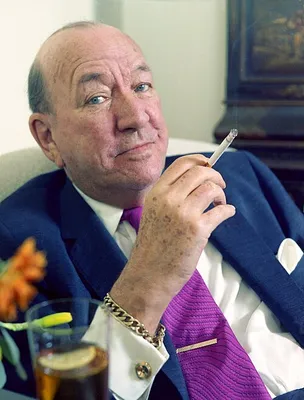
Sir Noël Coward was a celebrated English playwright, composer, and actor known for his wit and style, with a career spanning six decades.
Noël Coward was a prominent English figure in theatre and music, born in 1899. From a young age, he was drawn to the stage, making his professional debut at eleven. His mother encouraged his early theatrical pursuits, leading him to dance academies and various stage roles. He quickly became known for his sharp wit, flamboyant persona, and a distinctive sense of style that blended sophistication with a playful audacity.
Coward's prolific career extended across playwriting, composing, acting, and directing, producing over 50 plays, hundreds of songs, screenplays, poetry, and prose. Many of his plays, such as 'Hay Fever' and 'Private Lives,' remain staples of the theatrical repertoire. Beyond his artistic contributions, Coward also engaged in significant wartime efforts, including running a British propaganda office in Paris and working with the Secret Service to influence American support for Britain during World War II. He received an Honorary Academy Award and was knighted for his contributions.
Early Life and Theatrical Beginnings
Born in 1899 in Teddington, London, Noël Coward's early life was marked by modest family finances and a burgeoning passion for the theatre, fueled by his mother's ambition. He attended a choir school and received limited formal education, instead becoming a dedicated reader. His theatrical journey began with amateur performances at age seven, and by eleven, he had secured his first professional role in 'The Goldfish.' His early career involved appearances in various plays, including 'Where the Rainbow Ends' and 'Peter Pan,' where he met and collaborated with other young actors. During his teenage years, he was introduced into high society, a milieu that would heavily influence the settings of his later works. A significant early influence was painter Philip Streatfeild, who introduced him to influential social circles before his untimely death.
Rise to Prominence and Inter-War Successes
Coward's career gained momentum between the World Wars. He wrote his first plays in his late teens, collaborating with Esmé Wynne before penning his solo debut, 'The Rat Trap.' In 1920, at the age of twenty, he starred in his own play, 'I'll Leave It to You,' which marked his West End debut. While early reviews were mixed, they acknowledged his comedic talent and potential. His first significant critical and commercial triumph came in 1924 with 'The Vortex,' a play that explored themes of addiction and societal decay. Coward also made his first trip to America in 1921, absorbing the pace and style of Broadway, which influenced his writing, leading to successes like 'The Young Idea.' He also ventured into revue, co-writing and performing in 'Charlot's London Calling!'
Wartime Contributions and Later Career
At the onset of World War II, Coward dedicated himself to war efforts, heading the British propaganda office in Paris and assisting the Secret Service in garnering American support. His film 'In Which We Serve' earned him an Honorary Academy Award in 1943. The 1950s saw a resurgence in his popularity as a cabaret performer, showcasing his own hit songs. His prolific output continued with musical theatre, screenplays, poetry, short stories, a novel, and a three-volume autobiography. Coward's stage and screen work spanned six decades, during which he often performed his own material. He achieved further recognition with a knighthood in 1970. His plays and songs experienced renewed popularity in the 1960s and 70s, cementing his lasting influence on popular culture.
Legacy and Personal Life
Noël Coward's influence on popular culture persists, with his work and distinctive style continuing to inspire. While he did not publicly discuss his homosexuality during his lifetime, it became a subject of candid discussion following his death, explored by biographers and revealed through his posthumously published diaries and letters. His long-time partner, Graham Payn, was among those who discussed his personal life. In recognition of his immense contribution to the arts, the former New Theatre in London was renamed the Noël Coward Theatre in his honor in 2006. His legacy is that of a multifaceted artist who masterfully blended wit, style, and enduring theatrical and musical genius.
Key Ideas
- Wit and sophisticated dialogue
- Flamboyant personal style
- Exploration of high society
- Blending of comedy and drama
Notable Quotes
“My part was reasonably large and I was really quite good in it, owing to the kindness and care of Hawtrey's direction. He took endless trouble with me ... and taught me during those two short weeks many technical points of comedy acting which I use to this day.”
“One day ... a little advertisement appeared in the Daily Mirror.... It stated that a talented boy of attractive appearance was required by a Miss Lila Field to appear in her production of an all-children fairy play: The Goldfish. This seemed to dispose of all argument. I was a talented boy, God knows, and, when washed and smarmed down a bit, passably attractive. There appeared to be no earthly reason why Miss Lila Field shouldn't jump at me, and we both believed that she would be a fool indeed to miss such a magnificent opportunity.”
“gave me an orange and told me a few mildly dirty stories, and I loved her from then onwards.”
“two of the dullest Elizabethan writers ever known ... I had a very, very long part, but I was very, very bad at it”
“When Mr Coward has learned that tea-table chitter-chatter had better remain the prerogative of women he will write more interesting plays than he now seems likely to write.”
Books by D. M. Coward
0 free public domain books · Read online or download