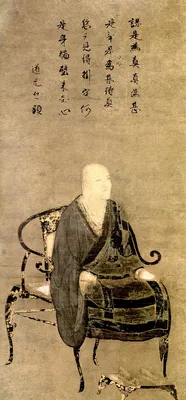
D Gen Zenji
Dōgen Zenji was a Japanese monk who founded the Sōtō school of Zen in Japan, emphasizing zazen.
Dōgen Zenji (1200–1253) was a pivotal figure in Japanese Buddhism, establishing the Sōtō school of Zen. Born into a noble family, he was ordained in the Tendai school but sought a more authentic Buddhist practice, leading him to travel to China. There, he trained under Tiāntóng Rújìng of the Cáodòng lineage, a transformative experience that deeply influenced his understanding of Zen. Upon returning to Japan, Dōgen dedicated himself to promoting zazen, or sitting meditation, through his writings and teachings. Dissatisfied with the established Buddhist institutions in Kyoto, he eventually founded the monastery Eihei-ji in the countryside, which became the main temple of the Sōtō school and remains so today. His extensive writings, particularly the Shōbōgenzō, are foundational texts for contemporary Sōtō Zen practitioners.
Early Life and Disillusionment
Born into a prominent family, Dōgen was an illegitimate child who lost his mother at a young age. He was fostered by his elder brother and initially ordained into the Tendai school on Mount Hiei. However, Dōgen became profoundly unsettled by the Tendai doctrine of inherent enlightenment, questioning why Buddhas sought enlightenment if it was already present. This, along with perceived political maneuvering and the emphasis on social standing within the school, led to his disillusionment. Seeking answers elsewhere, he briefly studied with other masters before being advised to travel to China to study Chan Buddhism.
Journey to China and Foundational Training
In 1223, Dōgen journeyed to China (Song dynasty) with his teacher Myōzen, aiming to deepen his understanding of Buddhism. While initially studying Chan monasteries that heavily emphasized kōan practice, he found himself dissatisfied with the focus and the neglect of sutras. A pivotal moment occurred when he encountered Tiāntóng Rújìng, a master of the Cáodòng lineage, at Mount Tiāntóng. Under Rujing's guidance, Dōgen experienced a profound realization of 'casting off body and mind' (shēn xīn tuō luò), a concept that would become central to his philosophy. He received Dharma transmission from Rujing in 1227, considering his life's quest fulfilled.
Establishing the Sōtō School and Literary Legacy
Returning to Japan in 1227 or 1228, Dōgen began promoting zazen through writings like the Fukanzazengi. Facing friction with the powerful Tendai school and other emerging Buddhist groups, he eventually left Kyoto to establish his own practice center. This evolved into the monastery Eihei-ji in Echizen province, founded in 1246 and now the principal temple of the Sōtō school. Dōgen spent his remaining years teaching and writing prolifically. His most significant work, the Shōbōgenzō, along with other texts like Eihei Kōroku and Eihei Shingi, forms the core of Sōtō Zen teachings and is highly regarded for its philosophical depth.
The Practice of Zazen
Central to Dōgen's teachings is the practice of zazen, which he equated with the study of Zen itself. He advocated for zazen as the primary method for all practitioners, regardless of background. Dōgen often referred to a specific form of zazen known as shikantaza, or 'just sitting,' characterized by alert, thought-free awareness. He also described this state as hishiryō, or 'non-thinking,' a state of pure awareness beyond conceptualization. His instructions emphasized detachment from worldly concerns and the cessation of mental activity, aiming for a direct experience of reality.
Key Ideas
- Zazen (sitting meditation) as the direct expression of enlightenment.
- Shikantaza ('just sitting') as a practice of pure, alert awareness.
- Mushō (non-thinking) as a state beyond conceptualization.
- The importance of 'casting off body and mind' for liberation.
Notable Quotes
“To study the Way is to study the Self. To study the Self is to forget the self. To forget the self is to be enlightened by all things of the universe. To be enlightened by all things of the universe is to cast off the body and mind of the self as well as those of others. Even the traces of enlightenment are wiped out, and life with traceless enlightenment goes on forever and ever.”
“For zazen, a quiet room is suitable. Eat and drink moderately. Cast aside all involvements and cease all affairs. Do not think good or bad. Do not administer pros and cons. Cease all the movements of the conscious mind, the gauging of all thoughts and views. Have no designs on becoming a Buddha. Zazen has nothing whatever to do with sitting or lying down.”
“settle into a steady, immobile sitting position. Think of not thinking (fushiryō). How do you think of not-thinking? Without thinking (hishiryō). This in itself i”
Books by D Gen Zenji
0 free public domain books · Read online or download
