D. G. Farnsworth
Edith Farnsworth, a physician, commissioned a modernist glass house from Mies van der Rohe, leading to a significant architectural landmark and legal dispute.
Edith Farnsworth, a physician and nephrologist, commissioned the renowned architect Ludwig Mies van der Rohe to design a weekend retreat for her on a site near Plano, Illinois. Completed in 1951, the resulting Edith Farnsworth House is a seminal work of modernist architecture, characterized by its minimalist design, extensive use of glass, and open plan. The house was notably elevated above the Fox River floodplain due to Mies's design decisions, despite Farnsworth's and a contractor's concerns about potential flooding.
The relationship between Farnsworth and Mies deteriorated during the construction process due to cost overruns and design disputes, leading to mutual lawsuits. Despite these challenges and initial criticisms regarding its practicality and energy efficiency, Farnsworth owned the house until 1972. The property later passed through other owners, including Peter Palumbo, who undertook renovations and opened it to the public. The house is now owned and operated by the National Trust for Historic Preservation and is recognized as a National Historic Landmark, influencing subsequent architectural designs.
Architectural Vision and Development
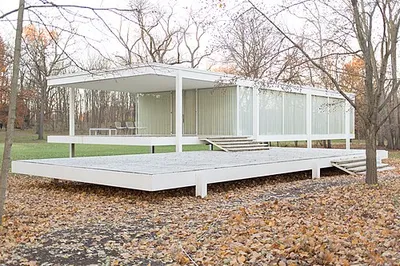
The Edith Farnsworth House, a significant modernist structure, was conceived as a weekend retreat for physician Edith Farnsworth and designed by Ludwig Mies van der Rohe. Farnsworth, a single, career-focused woman, met Mies in 1945 and engaged him to design a house on her property near Plano, Illinois. Mies, who had been developing his modernist aesthetic for decades and was keen on integrating interior spaces with the natural environment through glass walls, saw the project as an opportunity to realize his design objectives. Despite Farnsworth's and a local contractor's concerns about the site's proximity to the Fox River floodplain, Mies insisted on elevating the house approximately five feet above ground, a decision that became central to the design. The development process involved extensive diagramming and consideration of various materials and configurations, with the design partly exhibited at MoMA in 1947.
Design Philosophy and Materiality
Mies van der Rohe's design for the Farnsworth House prioritized a profound connection with nature, articulated through its extensive glass facades. The architect famously stated that viewing nature through the glass walls lends it a more significant presence, making it an integral part of a larger whole. The house's structure is defined by eight steel columns supporting concrete floor and roof slabs, creating a largely open interior plan. The exterior is characterized by glass panels interspersed with steel mullions, with one-third of the house functioning as an open-air veranda. Privacy and social considerations were secondary to Mies's architectural vision. The interior features a minimalist palette, with utilities, kitchen, and bathrooms consolidated in a central core, allowing living, dining, and sleeping areas to flow around it. Radiant heating was integrated into the floor, and the design aimed to let the outside in, embodying a core tenet of modernist architectural philosophy.
Construction, Disputes, and Legacy
The construction of the Farnsworth House, initiated in 1949, was marked by significant delays and spiraling costs, partly due to the elevated design, the lack of an access road, and the requirement for underground utilities. These factors, coupled with ongoing design compromises, led to a deterioration of the once cordial relationship between Edith Farnsworth and Mies van der Rohe. They ultimately sued each other in 1951, initiating a lengthy legal battle. Despite its initial controversy, stemming from its avant-garde modernist design and the architects' feud, the house has become a celebrated architectural landmark. Farnsworth retained ownership until 1972. Subsequent owners, including Peter Palumbo, undertook renovations, and the property was eventually opened to the public. It is now a National Historic Landmark, recognized for its profound influence on residential architecture and Mies's own body of work.
Key Ideas
- Integration of interior and exterior spaces through extensive glass facades.
- Minimalist design principles emphasizing openness and simplicity.
- Elevated structure to address site-specific challenges like floodplains.
- Architectural philosophy of bringing nature into the living environment.
Notable Quotes
“in that way we'll let the outside in”
“If you view nature through the glass walls of the Farnsworth House, it gains a more profound significance than if viewed from the outside. That way more is said about nature—it becomes part of a larger whole.”
Books by D. G. Farnsworth
0 free public domain books · Read online or download