Costi Lupu
Mihail Sadoveanu was a prolific Romanian writer known for historical novels, political involvement, and traditionalist literary associations.
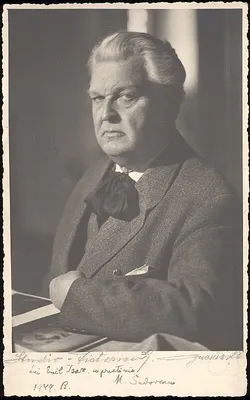
Mihail Sadoveanu, a prominent Romanian novelist and short story writer active for over five decades, was also a journalist and political figure. He is primarily remembered for his historical and adventure novels, often set in the historical region of Moldavia and drawing on medieval and early modern Romanian history. His nature writing also holds a significant place in his oeuvre.
Sadoveanu's early career saw him associated with the traditionalist magazine Sămănătorul and later the Poporanist current represented by Viața Românească. His literary style evolved, incorporating elements of psychological novel, Naturalism, and Social Realism in later works that extended to contemporary history. Politically, Sadoveanu navigated various parties throughout the interwar period, serving in Parliament and editing leftist newspapers. Following World War II, he aligned with the Romanian Communist Party, supporting the Soviet Union and adopting Socialist Realism, with some of his works and slogans seen as propaganda for communization. He held leadership positions in literary societies and was a member of the Romanian Academy, also serving as Grand Master of Romanian Freemasonry.
Early Life and Influences
Born in Pașcani, Mihail Sadoveanu's background was marked by a contrast between his father's educated, professional lineage and his mother's family of illiterate shepherds from Moldavia. This duality, along with his father's unhappy marriage and withdrawal from public life, is believed by critics to have contributed to his broad perspective. Sadoveanu's childhood was spent exploring the Moldavian countryside, hunting, and fishing, experiences that deeply informed his connection to nature and his understanding of rural society. His early education included time in Fălticeni and Iași, where he encountered future literary figures. Despite initial academic disinterest, he eventually excelled, demonstrating an early aptitude for writing.
Literary Beginnings and Evolution
Sadoveanu's literary journey began in his late teens, with early writings appearing in satirical and Symbolist journals. Dissatisfied with Symbolism, he shifted his focus to Realist prose. After a brief attempt at studying law, he dedicated himself to writing, marrying and settling in Fălticeni. His first published novella fragments appeared under a pseudonym. Drafted into the army, his experiences inspired social criticism narratives. He later settled in the countryside, raising a large family and writing prolifically. His early work was influenced by traditionalist journals like Sămănătorul and the Poporanist movement, known for its ruralist approach. He faced accusations of plagiarism early in his career, but his debut year in 1904 saw the release of four books, marking the beginning of a long and influential literary career.
Political Engagements and Ideological Stance
Throughout his career, Sadoveanu was a significant political figure, serving multiple terms in Parliament and holding acting head of state positions for the communist republic. His political affiliations shifted, moving between right- and left-wing forces during the interwar period. He was associated with various political parties and served as editor for leftist newspapers. After World War II, Sadoveanu became a supporter of the Romanian Communist Party, openly endorsing the Soviet Union and Stalinism. He joined organizations promoting Soviet friendship and embraced Socialist Realism in his writing. Works like the political novel Mitrea Cocor and the slogan "The Light Arises in the East" are considered examples of his propaganda efforts for the communist regime.
Key Ideas
- Exploration of Romanian medieval and early modern history in fiction.
- Themes of solitude and natural abundance, often set in Moldavia.
- Fusion of nationalism and Humanism in his worldview.
- Adaptation of literary styles to include psychological novel, Naturalism, and Social Realism.
- Use of literature as a tool for political propaganda, particularly in support of communism.
Books by Costi Lupu
1 free public domain book · Read online or download