Clan Henderson Society
Scottish clans are kinship groups with shared heritage, officially recognized and regulated by the Court of the Lord Lyon.
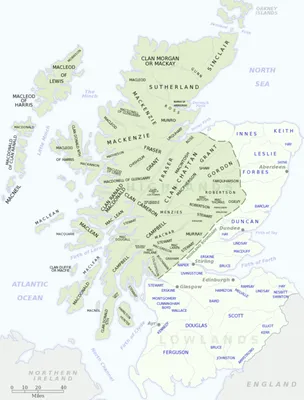
Scottish clans are defined as kinship groups that foster a sense of shared heritage and lineage among members. Historically, the image of clans with distinct tartans and territories was popularized in the 19th century, though tartan patterns originally indicated regional weaving styles. The modern clan structure is officially recognized by the Court of the Lord Lyon, which oversees heraldry and coats of arms. Many clans have a recognized chief, while others are armigerous. Clan membership is often associated with geographical areas historically controlled by the clan founder, sometimes featuring ancestral castles and regular gatherings. A common misconception is that all bearers of a clan name are direct descendants of the chief; many adopted the chief's surname for reasons of solidarity, protection, or sustenance, often without direct blood relation. The term 'clan' originates from the Gaelic word 'clann,' meaning 'children' or 'kindred.'
Historically, clan organization was based on concepts of 'dùthchas' (collective right to territory and protection) and 'oighreachd' (land ownership granted by charters). While 'dùthchas' emphasized collective heritage and the chief's authority as a trustee, 'oighreachd' focused on the chief's status as a landed proprietor. The legal framework evolved, with 'oighreachd' gaining prominence. Succession to chiefship, typically through male heirs, became more formalized. Disputes were often settled through arbitration overseen by the chief. Social bonds were strengthened through fosterage (raising children in other clan families) and manrent (contracts for protection), reinforced by 'calps' (death duties). Marriage alliances also played a role in solidifying relationships within and between clans.
Clan Structure and Recognition
Scottish clans are kinship groups where members share a sense of common heritage and descent. The modern clan system is officially recognized by the Court of the Lord Lyon, which regulates heraldry and coats of arms. Most clans are associated with specific tartan patterns, often originating in the 19th century, which members may use in clothing. Clans typically have a chief, though some are armigerous, meaning they lack a recognized chief. Clan identity is often linked to ancestral territories, sometimes with castles, and regular clan gatherings are a significant social feature. The concept of clan membership has evolved; while historically tied to territory and allegiance, today, bearing the chief's surname or offering allegiance generally confers membership, unless explicitly refused by the chief. Septs, which are associated surnames or families, are recognized by clans, though there is no official list, and individuals may need to research their genealogy to determine their correct clan affiliation.
Legal and Social Authority
The authority within Scottish clans was historically guided by two concepts: 'dùthchas' and 'oighreachd.' 'Dùthchas' represented the collective right to territory and the expectation of protection from the chief and leading gentry, who acted as trustees for the clan. 'Oighreachd,' on the other hand, emphasized the chief's authority as a landed proprietor, based on Crown charters and legal ownership of land. While 'dùthchas' was more prominent in the Middle Ages, 'oighreachd' gained precedence in the early modern period due to the increasing importance of Scots law and land charters. Succession to chiefship, known as 'tainistear,' was usually through the male line, with legal frameworks like the Law of Entail securing heritable succession and preventing the division of clan territories. Disputes, both criminal and civil, were typically resolved through arbitration panels overseen by the clan chief, with decisions being final.
Social Bonds and Alliances
Social cohesion within clans was maintained through various forms of bonding. Fosterage involved the children of chiefs being raised by favored members of the clan gentry, and vice versa, strengthening inter-family ties. Manrent agreements were contracts where family heads sought territorial protection from the chief, even if not residing on clan lands. These bonds were often reinforced by 'calps,' a form of death duty paid to the chief, typically a best animal, signifying personal allegiance. Although 'calps' were outlawed in 1617, manrent practices for protection continued covertly. Marriage alliances were also crucial, reinforcing relationships both within the clan and with neighboring clans. These alliances often involved commercial arrangements, including the exchange of livestock, money, and land, with the bride's dowry ('tocher') and groom's contribution ('dowry') representing significant aspects of these contracts.
Books by Clan Henderson Society
1 free public domain book · Read online or download