Christine Bengel
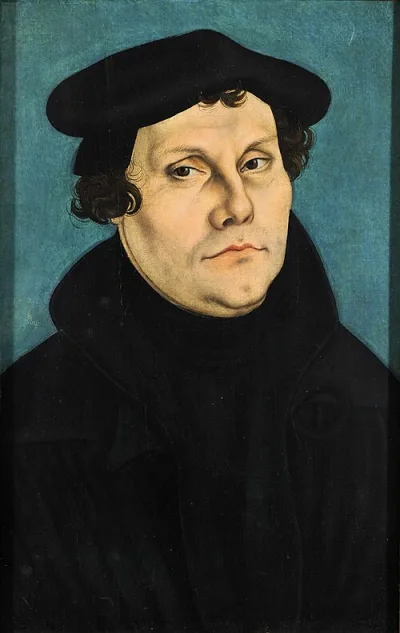
Martin Luther was a pivotal German theologian whose ideas sparked the Protestant Reformation and profoundly influenced Western thought.
Martin Luther (1483-1546) was a German priest and theologian whose theological challenges to the Roman Catholic Church initiated the Protestant Reformation. He questioned doctrines such as indulgences and papal authority, famously articulating his views in the Ninety-five Theses in 1517. His refusal to recant led to his excommunication by Pope Leo X and condemnation by Emperor Charles V. Luther's theology emphasized justification by faith alone through God's grace, rather than by human works. He asserted that the Bible was the sole source of divinely revealed truth, challenging the necessity of a priestly intermediary and proposing the concept of a universal priesthood of believers. His translation of the Bible into German made scripture accessible to the populace, significantly impacting German language and culture. Luther's work also influenced hymnody and the practice of clerical marriage. However, some of his later writings expressed virulent antisemitic views.
Early Life and Education
Born in Eisleben in 1483, Martin Luther was the son of Hans and Margarethe Luther. His father, a mine leaseholder and town councillor, desired for Martin to become a lawyer. Luther received his early education in Latin schools in Mansfeld, Magdeburg, and Eisenach, focusing on grammar, logic, and rhetoric. He later attended the University of Erfurt, where he earned a master's degree. Despite enrolling in law studies, Luther abandoned them, seeking greater assurance in theology and philosophy. He was influenced by tutors who encouraged critical examination of ideas and developed a deep interest in scripture, viewing it as the primary source of knowledge about God.
Monastic Life and Academic Career
Luther's decision to enter monastic life in 1505, joining the Augustinian order in Erfurt, was reportedly prompted by a terrifying thunderstorm and a vow to Saint Anna. This period was marked by intense spiritual struggle and self-examination. His superior, Johann von Staupitz, directed him toward an academic path to alleviate his introspection. Luther was ordained a priest in 1507 and began teaching theology at the University of Wittenberg in 1508. He earned doctorates in biblical studies and theology, eventually succeeding von Staupitz as chair of theology, a position he held for the remainder of his career. He also served as a provincial vicar, overseeing several monasteries.
Theological Development and the Reformation
Through his lectures on biblical texts like Psalms, Hebrews, Romans, and Galatians, Luther developed critical theological insights. He became convinced of the Church's corruption and the loss of core Christian truths. Central to his thought was the doctrine of justification by faith alone, positing that righteousness is a gift of God's grace received through faith in Jesus, not earned by human actions. Luther argued that Christians receive righteousness entirely from Christ, a concept known as monergism, contrasting with the synergistic view of co-operation with divine grace. He also championed the Bible as the ultimate authority in matters of faith and opposed the idea of a sacerdotal priesthood, advocating for all baptized Christians to be considered part of a holy priesthood.
Impact and Later Views
Luther's translation of the Bible into German made the scriptures widely accessible, profoundly influencing the development of the German language and culture. His hymns contributed to the evolution of music in Protestant worship. His marriage to Katharina von Bora, a former nun, established a precedent for clerical marriage within Protestantism. However, Luther's later works, such as 'On the Jews and Their Lies,' contained severe antisemitic rhetoric, advocating for the expulsion of Jews and the destruction of synagogues. While not directly calling for murder, historians suggest his writings contributed to the rise of antisemitism.
Key Ideas
- Justification by faith alone
- Sola Scriptura (Bible as sole authority)
- Priesthood of all believers
- Monergism (God's sole work in salvation)
Books by Christine Bengel
1 free public domain book · Read online or download