Christian J Guyonvarc H
Lugus is a Celtic deity known primarily through inscriptions, with debated connections to Roman Mercury and Insular mythological figures.
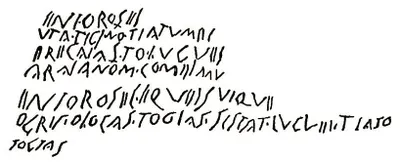
Lugus, also known as Lugos or Lug, is a Celtic god whose worship is documented through epigraphic evidence, mainly concentrated in the Iberian Peninsula from the 1st century BCE to the 3rd century CE. These inscriptions predominantly refer to the god in the plural as the Lugoves, leading to ongoing scholarly debate about their nature and relationship to a singular Lugus. While one early inscription from Spain is widely accepted as referring to Lugus as a singular entity, the god's name also appears in the etymologies of various Celtic personal and place-names.
Scholars have interpreted Julius Caesar's description of a prominent Gaulish deity, whom he equated with the Roman god Mercury, as a potential reference to Lugus. This interpretation is supported by comparisons with Insular mythological figures like the Irish Lugh and the Welsh Lleu Llaw Gyffes, who share certain attributes and etymological links. However, the reconstruction of Lugus as a pan-Celtic deity, first proposed in the 19th century, remains a controversial topic, with some aspects of the theory being abandoned while others continue to be defended.
Epigraphic and Linguistic Evidence
The worship of Lugus is primarily attested through inscriptions found in Continental Europe, particularly in Iberia, dating from the 1st century BCE to the 3rd century CE. A notable characteristic of these dedications is the frequent use of the plural form, 'Lugoves' or 'Lucoves,' rather than the singular 'Lugus.' The exact nature of these plural deities and their connection to a singular Lugus is a subject of considerable scholarly discussion. While a Celtiberian inscription from Peñalba de Villastar is generally agreed to mention Lugus as a singular entity, the interpretation of other inscriptions, such as the Chamalières tablet, remains debated. The element 'lug(u)-' also appears frequently in Celtic personal and place-names, suggesting a potential etymological link to the deity. Examples include personal names like Lugotorix and place-names such as Lugdunum (modern Lyon), which has been widely hypothesized to mean 'fortress of Lugus.'
Connections to Roman and Insular Mythology
Julius Caesar's account in his 'Commentaries on the Gallic War' describes a highly revered Gaulish deity, identified with the Roman god Mercury, as the inventor of arts, guide of travelers, and patron of commerce. Many scholars interpret this description as referring to Lugus, especially considering the prominence of the 'Lug(u)-' element in Gaulish place-names and the cult of Mercury in Roman Gaul. This identification is further explored through comparisons with figures from medieval Insular mythology. The Irish hero Lugh, known for his skills and association with a harvest festival, shares similarities with Caesar's description of Gaulish Mercury. Similarly, the Welsh figure Lleu Llaw Gyffes, though less prominent, is etymologically linked to Lugh and may share a connection with shoemaking, a potential attribute of the Lugoves. The reconstruction of a pan-Celtic Lugus based on these diverse elements has been a subject of scholarly debate since the 19th century.
Etymological Debates
The precise etymology of the name 'Lugus' is a complex and debated topic, with no single derivation achieving widespread consensus. A commonly cited theory links the name to the Proto-Indo-European root '*leuk-' meaning 'to shine,' suggesting Lugus might be a solar deity. However, this derivation faces phonological challenges and would likely result in a different form in Irish. Alternative hypotheses propose origins from Proto-Celtic words related to 'oath' or even animal names like 'lynx,' though the evidence for these is sometimes considered lacking. Other minority theories suggest connections to the Norse god Loki, or words for 'mouse,' 'rat,' or 'raven.' The lack of a definitive etymology contributes to the ongoing scholarly inquiry into the god's nature and origins.
Key Ideas
- Lugus as a Celtic deity known through epigraphy.
- The debate surrounding the singular Lugus versus the plural Lugoves.
- Potential identification of Lugus with Caesar's description of Gaulish Mercury.
- Connections to Insular mythological figures Lugh and Lleu Llaw Gyffes.
- Controversial reconstruction of Lugus as a pan-Celtic deity.
Notable Quotes
“Deum maxime Mercurium colunt. Huius sunt plurima simulacra: hunc omnium inventorem artium ferunt, hunc viarum atque itinerum ducem, hunc ad quaestus pecuniae mercaturasque habere vim maximam arbitrantur. Post hunc Apollinem et Martem et Iovem et Minervam. De his eandem fere, quam reliquae gentes, habent opinionem.”
Books by Christian J Guyonvarc H
0 free public domain books · Read online or download
