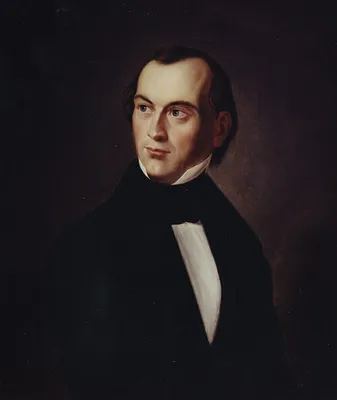
Christian A Lobeck
Karl Otfried Müller was a German classical scholar who pioneered a new approach to understanding ancient Greek myth and culture.
Karl Otfried Müller, born in 1797 in Silesia, was a prominent German scholar of classical Greek studies. Educated in Breslau and Berlin, he was significantly influenced by August Böckh, which spurred his interest in Greek literature, art, and history. Müller's academic career began with an appointment at the Magdaleneum in Breslau and later as an adjunct professor at the University of Göttingen, where he lectured on ancient art and history.
Müller's scholarly work marked a departure from Enlightenment views on myth. He proposed that ancient Greek myths were not merely reflections of universal religious infancy but rather emerged from the specific character of a people and their historical context. While this perspective emphasized cultural uniqueness, it also led him to question the influence of Egyptian art on Greek art, a view that differed from contemporary scholarly opinions. His academic pursuits were eventually interrupted by political unrest, leading him to seek travel abroad.
In his later years, Müller embarked on extensive research in Greece, including excavations at Delphi. He died in Athens in 1840 due to illness. His contributions significantly advanced the study of classical antiquity, particularly in the areas of Greek history, art, and mythology, establishing new standards for accuracy and analysis.
Scholarly Approach to Myth and Culture
Karl Otfried Müller challenged prevailing Enlightenment interpretations of Greek mythology. Instead of viewing myths as nascent stages of universal religion, he posited that they were the result of a unique interplay between a people's specific character and their historical circumstances. This framework emphasized the distinctiveness of each culture. Müller's work aimed to reconstruct a vibrant picture of ancient Greek life in its entirety. While he believed in the unique essence of each culture, this conviction led him to reject the notion of Egyptian influence on Greek art, a position that diverged from some of his contemporaries. His methodological approach laid groundwork for the scientific study of myths, seeking to understand their 'internal idea' and establishing techniques to discern their age and separate poetic embellishments from core narratives, all achieved before the widespread adoption of modern archaeological and philological methods.
Contributions to Classical Studies and Art History
Müller's scholarly output significantly advanced the fields of classical philology, archaeology, and art history. His major work, 'Geschichten hellenischen Stämme und Städte,' aimed to synthesize his life's research, though he only completed two volumes. He also published 'Die Etrusker,' a significant treatise on Etruscan antiquities, and introduced improved cartographic accuracy for ancient Greece. His 'Handbuch der Archäologie der Kunst' and 'Denkmäler der alten Kunst,' co-authored with Carl Oesterley, were instrumental in promoting the study of ancient art. Notably, Müller coined the German term 'pornographie' in the former work, which later gained international currency. His posthumously published 'Geschichte der griechischen Litteratur bis auf das Zeitalter Alexanders' was a foundational text for many years.
Later Life and Expeditions
Political difficulties in Göttingen in 1837 prompted Müller to seek permission to travel, and he departed Germany in 1839. After wintering in Italy, he arrived in Greece in 1840. During his time there, he meticulously investigated the ruins of ancient Athens and visited numerous sites in the Peloponnese. His journey culminated in Delphi, where he commenced archaeological excavations. Tragically, Müller succumbed to an intermittent fever and passed away in Athens. He was buried on the Colonus hilltop in Athens, near the grave of Charles Lenormant. A medal was struck in his honor in 1841, recognizing his substantial contributions to classical scholarship.
Key Ideas
- Mythology as an outcome of a people's character and historical setting, rather than universal religious infancy.
- Emphasis on the unique essence of individual cultures.
- Development of techniques for the scientific investigation of myths, including dating and separating poetic modifications.
Notable Quotes
“A democracy likes a large mass and hates all divisions.”
Books by Christian A Lobeck
0 free public domain books · Read online or download
