Chaucer, Geoffrey
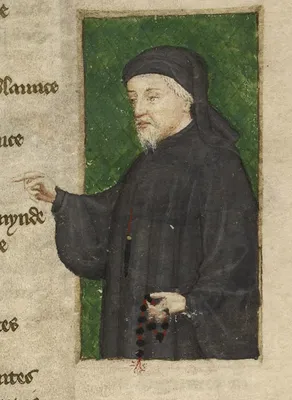
Geoffrey Chaucer, esteemed English poet, is celebrated for 'The Canterbury Tales' and his foundational role in English literature.
Geoffrey Chaucer (c. 1343–1400) was a pivotal English poet, writer, and public servant, widely recognized as a foundational figure in English literature and poetry. His literary output, including the renowned 'The Canterbury Tales,' significantly contributed to the acceptance and development of Middle English as a literary language, at a time when French and Latin were dominant. Beyond his literary achievements, Chaucer also pursued careers in philosophy and astronomy, notably composing 'A Treatise on the Astrolabe.' His public service included roles as a bureaucrat, courtier, diplomat, and Member of Parliament, demonstrating a multifaceted life dedicated to both the arts and governance.
Born in London to a family of vintners, Chaucer's early life and connections placed him within the royal court, serving various capacities for royalty like Elizabeth de Burgh and Edward III. His career involved significant travel, including during the Hundred Years' War where he was captured and ransomed. He married Philippa de Roet, and their family connections extended into prominent circles. Chaucer held important administrative positions, such as Comptroller of the Customs for the port of London, and was a Member of Parliament for Kent. Much of his significant literary work is believed to have been composed during periods of less documented personal life, yet his impact on the English language and literary tradition remains profound.
Literary Significance and Language
Geoffrey Chaucer is celebrated as a cornerstone of English literature, often hailed as its 'father.' His most famous work, 'The Canterbury Tales,' along with other significant pieces like 'Troilus and Criseyde,' played a crucial role in establishing Middle English as a legitimate literary medium. During his era, Anglo-Norman French and Latin were the prevailing languages for written works. Chaucer's skillful and prolific use of English in his poetry helped to elevate its status and accessibility, paving the way for future English literary traditions. His contemporaries recognized this contribution, with Thomas Hoccleve referring to him as the 'firste fyndere of our fair langage.' The extent of his linguistic impact is further evidenced by the thousands of English words first appearing in his manuscripts.
Public Service and Court Life
Chaucer led a distinguished career in public service, holding numerous official positions that provided substantial documentation of his life. He served as a page in the household of Elizabeth de Burgh, Countess of Ulster, through family connections, which introduced him to the royal court of Edward III. He subsequently worked as a courtier, diplomat, and civil servant, undertaking various roles including Clerk of the King's Works. His public duties involved extensive travel, both for military campaigns during the Hundred Years' War and for diplomatic missions across Europe, including France, Spain, Flanders, Italy, and Milan. These experiences likely informed his understanding of different cultures and social strata, potentially influencing his literary portrayals.
Intellectual Pursuits and Scientific Interests
Beyond his poetic endeavors, Chaucer demonstrated a keen interest in intellectual and scientific pursuits. He is recognized for his work in philosophy and astronomy. His composition of 'A Treatise on the Astrolabe' for his young son Lewis highlights his engagement with scientific knowledge and his desire to pass it on. This work showcases his understanding of astronomical instruments and calculations prevalent in the medieval period. While the primary focus of his legacy rests on his literary contributions, these scientific writings reveal a broader intellectual scope and a dedication to empirical observation and learning, positioning him as a multifaceted scholar of his time.
Notable Quotes
“the firste fyndere of our fair langage”
Books by Chaucer, Geoffrey
1 free public domain book · Read online or download