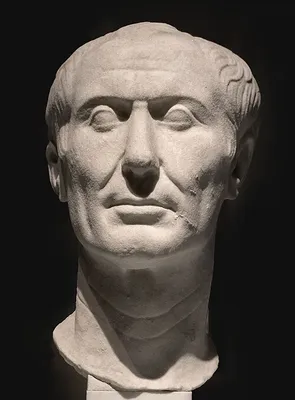
Charles J Caes
Gaius Julius Caesar was a pivotal Roman general, statesman, and author whose actions profoundly shaped Roman history.
Gaius Julius Caesar, born around 100 BC into an ancient patrician family, rose to become a dominant figure in the Roman Republic. He was a skilled general, leading Roman armies in the Gallic Wars and expanding Roman territory significantly. His political maneuvering, alongside allies Crassus and Pompey in the First Triumvirate, allowed him to amass power, though this alliance eventually fractured.
Caesar's defiance of the Senate by crossing the Rubicon initiated a civil war, which he ultimately won, leading to his consolidation of power. He enacted numerous reforms, including the creation of the Julian calendar. His increasing authority and perceived ambition led to his assassination by a group of senators in 44 BC, an event that precipitated further civil wars and the eventual transition of the Republic to the Roman Empire under his heir, Octavian.
Beyond his military and political achievements, Caesar was also an author. His own accounts of his campaigns are significant historical sources, offering insight into his life and actions. His influence extended beyond his lifetime, with his name becoming a title synonymous with emperor.
Early Life and Lineage
Gaius Julius Caesar was born into the distinguished Julian clan, which traced its lineage back to the legendary figures of Rome's founding and even claimed divine ancestry through Venus. Despite this ancient pedigree, the family held limited political sway during the mid-Republic. Caesar's father was a moderately successful politician, and his mother belonged to the influential Aurelii Cottae family. Caesar's early life was marked by his marriage to Cornelia, daughter of Lucius Cornelius Cinna, during a period of political upheaval. This union, along with his appointment as a priest of Jupiter, initially suggested a less prominent political future for Caesar. However, following his father's death and Sulla's victory, Caesar refused to divorce Cornelia, demonstrating an early defiance that may have placed him on proscription lists.
Military Service and Oratorical Pursuits
After leaving Italy to serve in Asia, Caesar gained military experience and distinguished himself by saving a fellow soldier's life at the Siege of Mytilene, earning the civic crown. He also visited Bithynia, where his stay with King Nicomedes IV later fueled rumors. Following Sulla's death, Caesar returned to Rome and began a career as a prosecutor, targeting members of the Sullan aristocracy. Though initially unsuccessful, he later secured a conviction against Gaius Antonius Hybrida. Seeking further refinement in public speaking, Caesar traveled to Rhodes to study rhetoric, but his journey was interrupted by a notable encounter with pirates, an event later embellished in historical accounts. His studies were again cut short by the Third Mithridatic War, during which he is said to have raised troops and engaged enemy forces.
Political Ascent and Reforms
Caesar's political career gained momentum when he was co-opted into the pontifices, a significant aristocratic honor. Returning to Rome, he was elected military tribune and actively advocated for the restoration of plebeian tribunate rights and the pardon of political exiles. His quaestorship in Hispania Ulterior granted him a lifetime seat in the Senate. The deaths of his aunt Julia and his wife Cornelia, shortly after the birth of their daughter Julia, were marked by public eulogies. After assuming significant power, Caesar implemented numerous reforms, including the establishment of the Julian calendar, adjustments to the grain dole, and the extension of Roman citizenship. His proclamation as 'dictator for life' in 44 BC underscored his supreme authority, setting the stage for his eventual assassination.
Key Ideas
- Consolidation of political power through military success and strategic alliances.
- The transition from Roman Republic to Roman Empire.
- The impact of calendrical reform on Roman society.
Books by Charles J Caes
0 free public domain books · Read online or download
