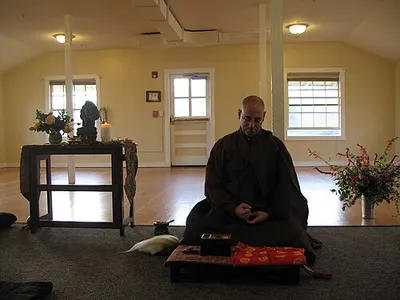
Chade Meng Tan
Norman Fischer is an American poet, Soto Zen priest, and writer known for his work in Zen practice and interreligious dialogue.
Zoketsu Norman Fischer is an American poet, writer, and Soto Zen priest, ordained in the lineage of Shunryu Suzuki. He received Dharma transmission from Sojun Mel Weitsman in 1988 and served as co-abbot of the San Francisco Zen Center from 1995 to 2000. In 2000, he established the Everyday Zen Foundation, a network for Buddhist practice groups across North America.
Fischer's background includes a Jewish upbringing and extensive academic study in religion, philosophy, and literature. His Zen training began at the Berkeley Zen Center, followed by a period of monastic life at Tassajara. He has held various leadership roles at Green Gulch Farm Zen Center and the San Francisco Zen Center, where he was instrumental in establishing a women's lineage chant and paper.
Beyond his direct Zen activities, Fischer has applied contemplative practices to fields like business, law, and education, notably co-developing the "Search Inside Yourself" mindfulness course at Google. He is also a proponent of interreligious dialogue, advocating for collaboration among different faiths to address global challenges, and has been active in Jewish meditation movements.
Zen Practice and Leadership
Norman Fischer trained extensively in Soto Zen, beginning at the Berkeley Zen Center under Sojun Mel Weitsman, and later undertaking monastic training at Tassajara. He received Dharma transmission in 1988 and served as co-abbot of the San Francisco Zen Center from 1995 to 2000. Following this, he founded the Everyday Zen Foundation to support Buddhist practice groups. Fischer has also integrated Zen principles into secular contexts, including founding the Zen Hospice Project and co-developing the "Search Inside Yourself" program for mindfulness and emotional intelligence, initially taught at Google. He has also consulted with military chaplains and taught at various universities.
Interreligious Dialogue and Jewish Roots
A strong advocate for interreligious dialogue, Fischer believes that religious traditions have a crucial role in addressing contemporary global issues. He has participated in interfaith meetings and serves on the Board of World Religious Leaders for the Elijah Interfaith Institute. Fischer also maintains a deep connection to his Jewish heritage, co-founding Makor Or, a Jewish Meditation Center, and exploring Jewish themes in his writing. His book "Opening to You" offers Zen-inspired reinterpretations of the Psalms, replacing traditional divine names with "You" to emphasize relational connection.
Writing and Poetic Contributions
Fischer is a prolific writer, with over twenty-five published books encompassing poetry and non-fiction. His poetry, often described as avant-garde and spiritually oriented, emerged from his association with the L=A=N=G=U=A=G=E poetry movement. His early work was influenced by his time at Tassajara. Critics like Charles Bernstein and Ron Silliman have praised his writing. He has also authored numerous essays on Zen, poetry, and spirituality, published in various Buddhist and literary journals. Fischer also serves as the literary executor for poet Philip Whalen.
Key Ideas
- Integration of Zen practices into secular fields like business and education.
- Importance of interreligious dialogue for addressing global challenges.
- Reimagining traditional religious language to foster deeper relational connection.
- The intersection of avant-garde poetry and spiritual exploration.
Notable Quotes
“I feel that in our period it is the challenge of religious traditions to do something more than simply reassert and reinterpret their faiths, hoping for loyal adherents to what they perceive to be the true doctrine. Looking back at the last century, with its devastating wars and holocausts and the shock of ecological vulnerability, I have the sense that religious traditions must now have a wider mission, and it is in the recognition of this mission, I believe, that interreligious dialogue becomes something not only polite and interesting, but also essential.”
“For many of the religious seekers I encounter, the word God has been all but emptied of its spiritual power. The relationship to God that is charted out in the Psalms is a stormy one, co-dependent, passionate, confusing, loyal, petulant, sometimes even manipulative. I wanted to find a way to approach these poems so as to emphasize the relational aspect, while avoiding the major distancing pitfalls that words like God, King, Lord and so on create.”
Books by Chade Meng Tan
0 free public domain books · Read online or download
